

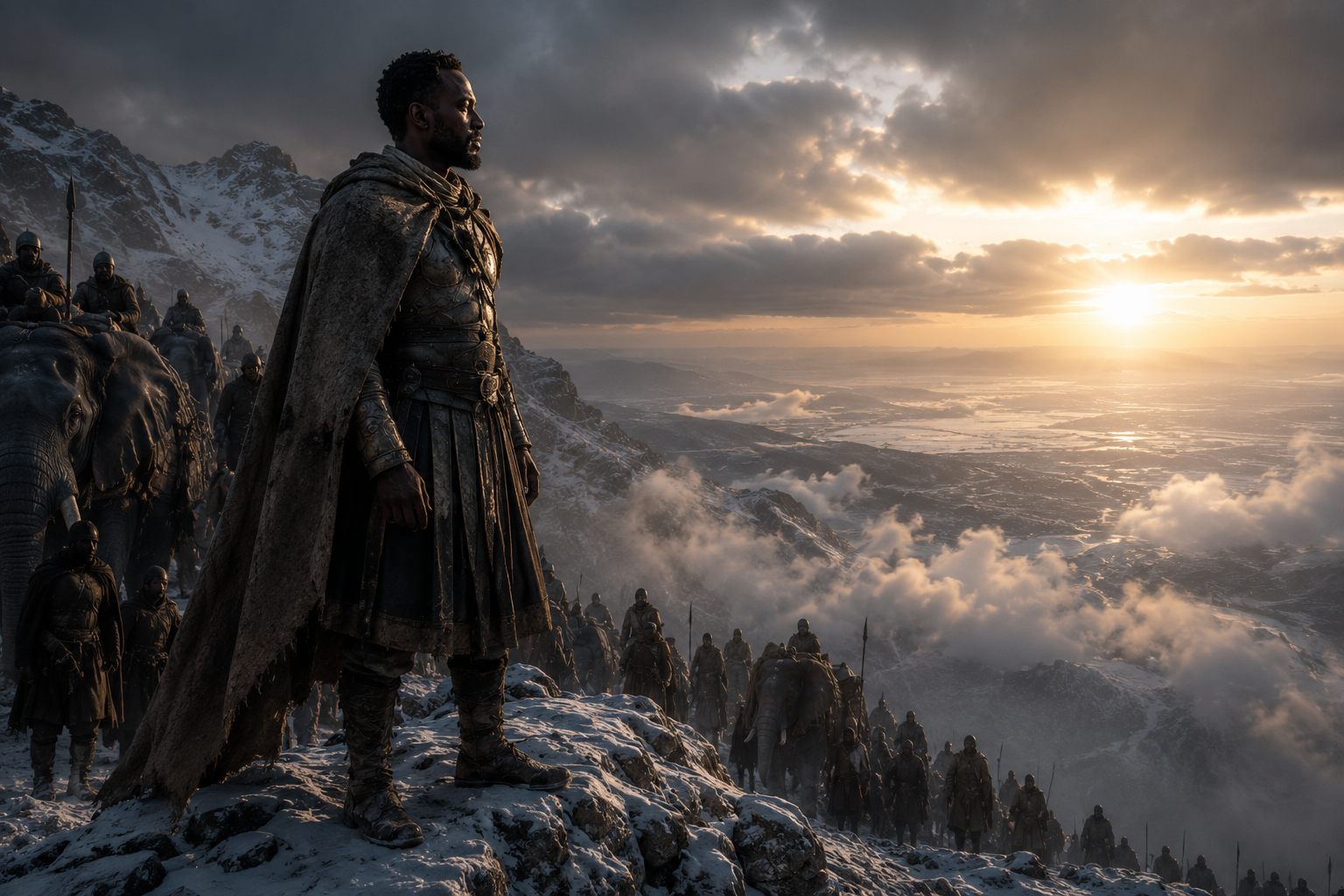
What would hannibal do
At twelve, I was already becoming “The Voice,” winning the Toastmasters Civic Oration Contest three years in a row. Then an adopted uncle told me about Hannibal, the North African general who crossed the Alps and invaded Italy from the direction Rome thought impossible. I thought he was teaching me history. He was teaching me how to think.
KonCite · Think Different
Find the Back Side of the MountainWhat Hannibal Taught a Twelve-Year-Old Black Boy About Strategy, Voice, and the Courage to Arrive Where No One Is Looking
Rome watched the sea. Hannibal crossed the mountains. At twelve, I learned that the smartest way forward is sometimes the route everyone else has dismissed as impossible.
THE BOY WHO BECAME “THE VOICE”
I was twelve years old when I learned that a mountain can be more than an obstacle.
It can be a hiding place.
It can be a strategy.
It can be the very thing that protects you from the expectations of people who are convinced they already know how you will arrive.
By middle school, I had become what people around me called “The Voice.” Toastmasters sponsored a Civic Oration Contest, and for three consecutive years I won. By thirteen, I would place second in the state. But the story I am telling begins one year earlier, when I was twelve: a Black boy in North Carolina learning that words could make a room listen before I fully understood what my voice might one day be asked to carry.
Military families know how to build kinship out of geography. We moved. We adapted. We made family wherever duty placed us. Some of the men around me were not related by blood, but they became uncles because love, guidance, and presence had made the adoption official long before paperwork ever could.
One of those adopted uncles was a college professor.
He saw the boy who could speak. Then he gave that boy a strategy.

THE HISTORY LESSON THAT BECAME A MENTAL MODEL
One day, my uncle told me about Hannibal Barca.
He did not begin with a date. He did not begin with a list of battles. He did not make me memorize the names of Roman consuls or the political machinery of the Second Punic War.
He told me the story the way a mentor tells a young person something he hopes will survive long after the details have faded.
There was a Carthaginian general from North Africa, he told me, who defeated Roman armies after bringing his soldiers across the Alps and descending into Italy from the direction Rome did not expect.
In the language available to us then, he called Hannibal a Black Carthaginian general. Historians are right to caution that modern racial categories do not map neatly onto the ancient Mediterranean. Carthage was a North African civilization with Phoenician roots, shaped by centuries of African and Mediterranean exchange. But at twelve, the classification carried a different kind of truth for me: one of history’s great strategic minds came from Africa, and nobody had thought to tell me.
That discovery moved me.
I had been taught about power as force. Hannibal introduced power as imagination.
I had been taught that overcoming an obstacle meant pushing harder against it. Hannibal taught me to ask whether the obstacle had another side.
I had been taught that victory belonged to the strongest person in the room. Hannibal taught me that the strongest person can still be standing in the wrong room.
My uncle thought he was giving me a history lesson.
He was giving me permission to think beyond the map.
ROME WAS WATCHING THE WRONG DIRECTION
The Alps are not the tallest mountains in the world. That distinction belongs to the Himalayas, crowned by Mount Everest. But to an army in 218 BCE, the Alps were not a scenic inconvenience. They were cold, steep, dangerous, politically contested terrain. They were a natural wall between Hannibal’s forces and the Italian peninsula.
Rome’s strategic confidence depended partly on geography. Carthage was Rome’s great rival across the Mediterranean. Roman leaders expected war to move through recognizable corridors—across water, along coasts, or through routes that armies and fleets could contest.
Hannibal began in Iberia. He moved north, crossed the Pyrenees, passed through Gaul, crossed the Rhône, and turned toward the Alps. Ancient accounts describe hostile communities, narrow paths, falling rock, snow, exhaustion, hunger, and staggering losses. Scholars still debate which Alpine pass he used, and ancient troop figures vary. None of that diminishes the essential fact.
He arrived.
That one word is the sermon.
He arrived with fewer soldiers than he had started with. He arrived after a journey many reasonable people would have called reckless. He arrived before Rome had emotionally accepted that he could.
Rome was watching for an invasion.
Hannibal attacked its imagination first.
Power often makes a dangerous mistake: it confuses “unlikely” with “impossible.” Once a system decides a route is impossible, it stops guarding it with the same seriousness. Difficulty becomes camouflage.
Hannibal did not cross the Alps because mountains are inspiring. He crossed because the hardship purchased strategic surprise. The mountain was not only the obstacle. The mountain was the cover.
How Hannibal changed the battlefield
Study the expectation
Rome prepared for the routes it believed an enemy was supposed to use.
Find the blind spot
The Alps looked too difficult to function as an invasion corridor.
Price the crossing
The route cost lives, animals, energy, and time. Surprise was not free.
Arrive differently
Hannibal descended into northern Italy before Rome had prepared for that reality.
Make power react
Rome began the campaign responding to Hannibal’s decisions rather than directing its own.

CANNAE: WHEN MORE BECAME LESS
Crossing the Alps made Hannibal unforgettable. What he did after crossing made him dangerous.
At the Trebia River, he used weather, timing, terrain, concealment, and Roman impatience. At Lake Trasimene, he drew Roman troops into one of antiquity’s most devastating ambushes. Then came Cannae in 216 BCE.
Rome gathered an enormous force. Ancient estimates differ, but Rome clearly held the numerical advantage. The Republic was tired of embarrassment. It wanted one decisive collision in which size, discipline, and mass would finally erase the Carthaginian problem.
Hannibal understood the desire.
That is the part people miss. Strategy is not only knowing what you want to do. It is understanding what the other side is desperate to do.
He arranged his forces so that the center could bend backward under Roman pressure while stronger infantry held the sides. The Romans pushed forward. Their numbers, which should have been an advantage, compressed them into a dense space. Carthaginian and allied troops closed from the flanks. Cavalry struck from behind.
The Roman army did not merely lose.
It was surrounded by the consequences of its own momentum.
Military historians call the maneuver a double envelopment. I call it a warning: sometimes the force with the most power loses because it has become predictable.
Rome brought more men.
Hannibal brought a better understanding of what those men would do.
Think like Rome—or think like Hannibal
| Rome’s instinct | Hannibal’s instinct |
|---|---|
| Protect the obvious entrance | Search for the neglected entrance |
| Use greater force | Create a better position |
| Assume difficult means impossible | Ask whether difficulty creates surprise |
| Fight on familiar terrain | Change what the terrain means |
| Push forward | Invite the opponent forward |
| Trust the institution’s map | Study the institution’s assumptions |
THE LESSON GETS STRONGER WHEN WE TELL THE WHOLE TRUTH
Now, let me tell the whole truth, because motivation without accuracy is just a pep rally with footnotes missing.
Hannibal won astonishing victories. Carthage still lost the war.
Rome adapted. It stopped feeding armies into the confrontations Hannibal designed. It rebuilt. It attacked Carthaginian interests elsewhere. It carried the war back to North Africa. Scipio Africanus defeated Hannibal at Zama in 202 BCE.
That does not cancel Hannibal’s lesson. It completes it.
A surprising entrance is not the same thing as a sustainable system.
A brilliant maneuver cannot permanently replace reinforcement, supplies, political unity, and long-term infrastructure. Hannibal changed the battlefield. Rome survived long enough to change the war.
So the lesson is not merely: surprise them.
The deeper lesson is: find the route that changes your position, then build what allows you to remain there.
Do not cross the mountain for applause.
Cross because something strategically important exists on the other side.
THE VOICE NEEDED A STRATEGY
At twelve, I did not know all of that. I did not know the route debates. I did not know how carefully Polybius and Livy would have to be read, or how later historians would reconstruct the campaign.
I knew only this:
Rome was looking one way.
Hannibal came from another.
And a Black professor I loved thought a Black boy needed to know.
That matters.
Representation is sometimes discussed as though its only purpose is self-esteem. But a child does not simply need to see someone who looks like him standing in a famous place. He needs access to the intellectual tools that person represents.
My uncle did not give me Hannibal as decoration.
He gave me Hannibal as method.
At the same time, the Civic Oration Contest was teaching me how to command a room. I was learning cadence. I was learning how silence can function inside a sentence. I was learning that a voice is not just volume—it is structure, breath, timing, conviction, and trust.
Hannibal gave the voice direction.
The contests taught me how to speak.
My uncle taught me how to approach the mountain.
Looking back, those were not separate lessons. The voice and the strategy were growing together.
I WAS STILL LOOKING FOR THE BACK SIDE OF THE MOUNTAIN
There are moments in adulthood when I can still hear that lesson.
When I entered graduate school and learned that institutions have front doors, side doors, locked doors, and doors that are technically open but somehow never seem to recognize your hand on the handle.
When I began studying psychosocial stress and asked questions that did not fit neatly inside one discipline.
When I looked at public health, racism, technology, institutions, and Black life and refused to believe they were unrelated simply because universities had placed them in different departments.
When I started building KonCite—not as another place to publish words, but as a platform for turning lived experience, evidence, and institutional critique into public intelligence.
Again and again, I found myself looking for the back side of the mountain.
Not because the harder route is always better. It is not.
Not because convention is always foolish. It is not.
But because systems often protect themselves by teaching us that their preferred entrance is the only legitimate entrance.
Apply again.
Wait your turn.
Ask the acceptable question.
Use the approved vocabulary.
Stay in your lane.
Do not build until you are invited.
Do not speak until your credentials make everyone comfortable.
That is Rome handing you its map.
Your inner Hannibal does not require you to become reckless. It asks you to become observant.
Where are they looking?
What are they assuming?
Which route have they dismissed?
What advantage becomes possible only if you are willing to arrive differently?

Call up your inner Hannibal
- Identify Rome. What powerful system, convention, competitor, or expectation defines the field?
- Name the assumption. What does everyone believe must be true?
- Find the Alps. Which route is dismissed because it appears difficult, indirect, unfamiliar, or improper?
- Price the crossing. What will the unconventional route cost in time, money, credibility, relationships, and stamina?
- Build the position. What advantage becomes possible only after the crossing?
- Plan beyond arrival. What infrastructure will allow the victory to last?
DO NOT CONFUSE STRATEGY WITH SPECTACLE
Now let me preach this carefully.
Do not choose a mountain merely because it is hard.
Some routes are difficult because they are badly designed. Some doors are closed because there is a better door. Some dramatic risks are not strategy; they are spectacle wearing expensive shoes.
Your inner Hannibal is not permission to quit your job on Tuesday with no plan and announce on Wednesday that you are “disrupting the industry.”
It is not permission to ignore evidence because boldness feels spiritual.
It is not permission to suffer unnecessarily just so the story sounds heroic later.
The lesson is not: choose the hardest route.
The lesson is: choose the route that changes the game.
Ask whether the crossing produces a position you could not have reached through the expected path. Ask whether you can survive it. Ask what resources must cross with you. Ask who must be waiting when you arrive. Ask whether the people following you understand the plan, or whether they simply saw you point at a mountain and got nervous.
Hannibal did not become great because he loved snow.
He became great because he understood what Rome could not imagine.
THE UNCLE WHO HANDED ME A MOUNTAIN
I was twelve when my adopted uncle placed that story in my hands.
Twelve.
Old enough to stand before judges and make a room listen. Young enough to have no idea what kind of life that voice might build.
I sometimes wonder whether he knew what he was doing.
Did he know that the story would remain with me through graduate school, research, fatherhood, institutional battles, failures, reinventions, and the building of something new?
Did he know that thirty-two years later I would still hear the lesson whenever somebody said, “That is not how this is done”?
Maybe he did.
Professors understand that ideas are seeds. Uncles understand that boys need someone to place possibility close enough to touch.
He gave me both.
At twelve, I thought I had learned about a general.
At forty-four, I understand that I learned about myself.
FIND THE OTHER SIDE
Every generation receives a map.
The map shows the roads that already exist. It marks the gates that powerful people recognize. It tells us where the entrance is supposed to be, which credentials count, which questions are respectable, and how long we are expected to wait before calling ourselves ready.
Use the map.
Study it.
Respect what it knows.
But do not worship it.
Because somewhere beyond the line everyone has agreed not to cross, there may be another route.
Your mountain may be a degree nobody in your family has earned.
It may be the business everyone says is too ambitious.
It may be a book that refuses the categories publishers understand.
It may be a research question hiding between disciplines.
It may be a healthier way of parenting than the one you inherited.
It may be the courage to leave a system that knows how to use your gifts but has never learned how to value your humanity.
It may be the platform you have been waiting for someone else to build.
Hear me: the mountain is not proof that you should stop.
But neither is it proof that you should charge straight ahead.
Walk around it. Study it. Learn its weather. Count the cost. Gather your people. Build the supply line. Find the route that changes where you stand.
Rome may be watching the front door.
Let it watch.
You were not born only to arrive where other people expect you.
You have a voice. Give it strategy.
You have a vision. Give it a route.
You have a mountain. Find its other side.
And when the world finally turns around and asks how you got there, do not apologize for arriving differently.
Tell them the truth.
You stopped attacking where they were waiting.
You found the back side of the mountain.
You have a voice. Give it strategy. You have a mountain. Find its other side.
Find the back side of the mountainSources and historical notes
This essay uses a personal memory as its frame and ancient and modern historical scholarship for the campaign.
