

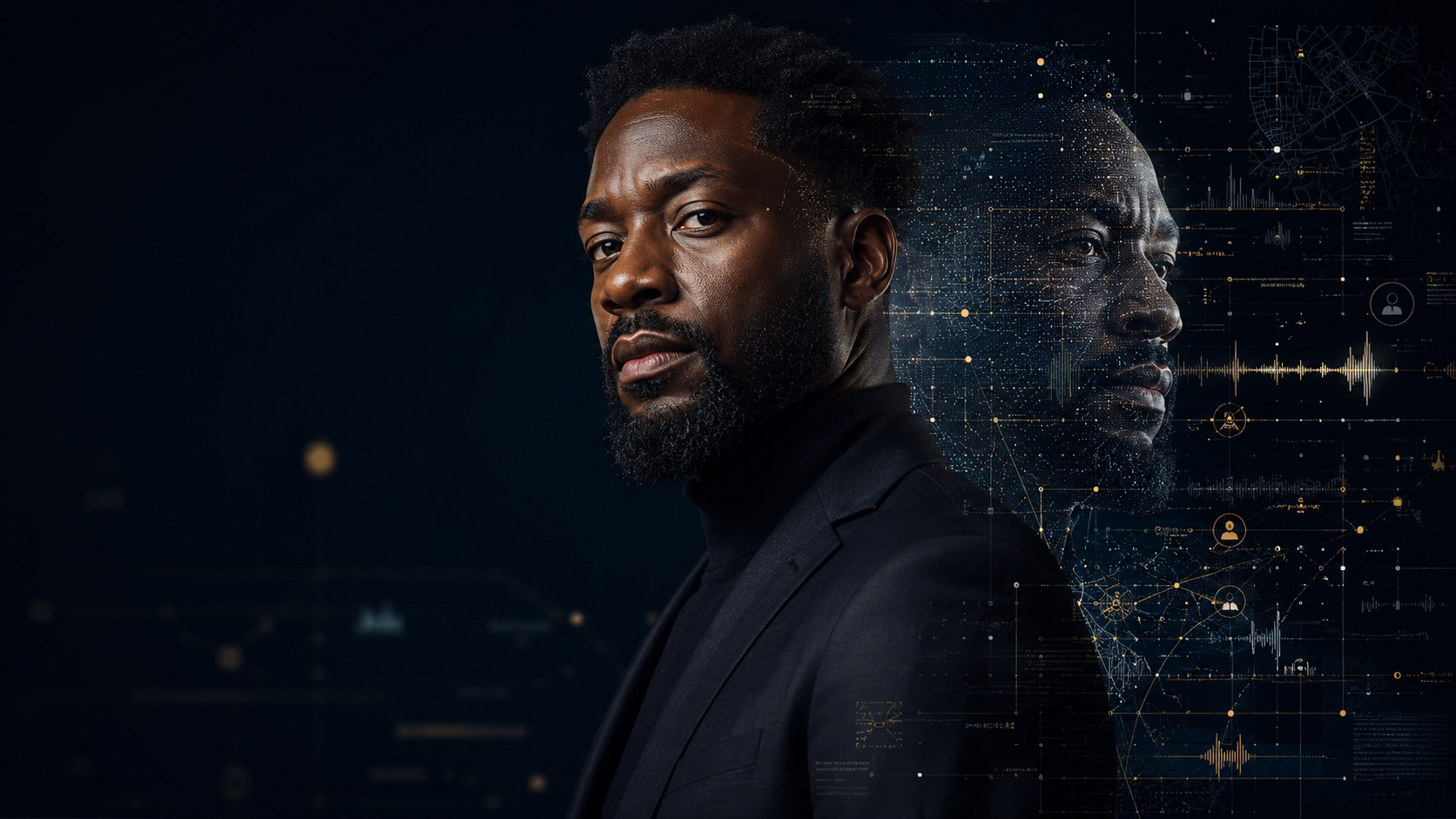
Who owns the black digital twin?
Artificial intelligence is learning to simulate bodies, predict disease, model behavior, and create digital representations of human lives. These systems may improve healthcare, but they also raise a question that medicine and technology have repeatedly avoided:
Who owns the Black digital twin?
This investigation examines how Black health data can be extracted, modeled, commercialized, and governed without meaningful community ownership. It explores consent, compensation, privacy, algorithmic bias, intellectual property, data sovereignty, and the difference between being represented in a system and having power over it.
The future of precision medicine cannot be equitable if Black communities remain data suppliers while others own the model, the platform, the patent, and the profit.
KonCite · Investigative Public Intelligence
Who Owns the Black Digital Twin?
As artificial intelligence systems construct increasingly detailed representations of individuals, families, communities, and populations, Black identity may become a commercially valuable simulation before Black institutions establish any rights over it.
A person no longer enters an institution alone. They arrive with a data trail.
Searches. Purchases. Locations. Photographs. Medical histories. School records. Court records. Workplace evaluations. Voice samples. Social connections. Insurance claims. Device identifiers. Faces captured by cameras the person may never see. Opinions revealed through clicks. Preferences inferred from pauses. Risks assigned through patterns that may have little meaning to the person but enormous value to the system evaluating them.
Each trace appears small in isolation. Together, they can become a second presence—a machine-readable representation built to predict what the person may do next.
The representation may not resemble a human body. It may never appear as a visible avatar. It may exist as a cluster of scores, associations, embeddings, categories, probabilities, and inferred characteristics distributed across several databases. Yet when a lender, employer, hospital, school, insurer, government agency, or digital platform relies on that representation, it begins to operate as something more consequential than a record.
It becomes a decision-making stand-in.
This investigation calls that stand-in the Black digital twin.
The term requires precision. In engineering, a digital twin often refers to a dynamically connected virtual representation of a physical object, process, or system. Here, “Black digital twin” functions as investigative shorthand for a synthetic identity model constructed from data and used to predict, classify, simulate, represent, or make decisions about a Black person or population.
The distinction matters. The Black digital twin is not yet one universal technical object. It is a growing institutional condition.
An institution does not need to know the whole person. It only needs to trust its representation of that person enough to act.
The digital twin becomes powerful when an institution trusts the simulation more than the person it claims to represent.
A synthetic profile can influence opportunity without ever introducing itself. It can affect which risk a system notices, which advertisement a platform serves, which applicant receives scrutiny, which patient receives outreach, and which person must prove that the machine misunderstood them.
Public discussion often reduces synthetic identity to deepfakes, cloned voices, or computer-generated avatars. Those technologies matter. But the most influential digital twin may never speak in a stolen voice or appear in a fabricated video.
It may remain invisible.
A health system can construct a risk profile from diagnoses, missed appointments, medications, neighborhood conditions, and prior use of care. An employer can combine application information with assessments, productivity measures, or inferred behavioral patterns. A school can transform attendance, discipline, test scores, and intervention histories into an early-warning profile. A financial institution can use a mixture of direct information and behavioral proxies to classify eligibility or price risk.
The person experiences the outcome. The institution sees the profile.
The difference between those two perspectives is where power accumulates.
Artificial intelligence does not need to prove that its representation captures a complete person. It only needs to produce an output that appears useful, scalable, and credible within an institutional workflow.
For Black people, that governance gap carries historical weight.
Black life has repeatedly entered administrative systems through someone else’s categories. Plantation ledgers converted human beings into inventory. Medical records converted suffering into professional interpretation. Police reports converted disputed encounters into official narratives. Credit files converted past transactions into future access. School records converted childhood behavior into durable institutional memory.
The technologies changed. The authority to describe remained concentrated.
Figure 1
Person → Data Trail → Synthetic Profile → Institutional Decision
How a digital twin becomes operational inside institutions.
-
1
Person
The living individual with context, memory, relationships, intention, contradiction, and agency.
-
2
Data Trail
- Search history
- Location
- Purchases
- Biometrics
- Medical, school, employment, and court records
- Posts, voice, and image data
-
3
Synthetic Profile
- Risk score
- Predicted preference
- Behavioral model
- Voiceprint or likeness
- Identity match
- Fraud, health, or retention prediction
-
4
Institutional Decision
- Healthcare
- Hiring
- Credit and insurance
- Education
- Public benefits
- Surveillance and marketing
The first danger is not simply that the digital twin can be wrong. The deeper danger is that the wrong representation can become durable.
A person changes. A profile may not. A person explains context. A database may preserve the category. A person disputes an event. A later institution may receive only the record created by the first.
A child may outgrow a disciplinary label while the data follows them into a new evaluation. A patient may recover while an old risk classification continues to shape outreach. A worker may correct an error in one system without knowing that a derived inference survives elsewhere. A community may challenge a stereotype while machine-learning systems continue detecting patterns shaped by older forms of discrimination.
Computational output does not become racially neutral merely because a machine produced it.
A flawed record once sat inside one institution. A flawed synthetic profile can become portable.
It can move through data partnerships, vendor platforms, scoring systems, identity tools, and model outputs. Each new use can make the representation appear more legitimate because another institution already relied upon it.
Repetition begins to resemble confirmation.
Table 1
Digital Twin Uses and Risks
The same capability can create benefit and harm. Governance determines which outcome becomes institutional practice.
| Domain | What the twin does | Potential benefit | Primary Black risk | Governance question |
|---|---|---|---|---|
| Healthcare | Predicts risk, need, or likely service use | Earlier outreach and coordinated care | Biased triage, opaque profiling, or unequal intervention | Can the patient inspect and correct the representation? |
| Credit and insurance | Estimates eligibility, pricing, or risk | Faster decisions and tailored products | Exclusion, higher pricing, or proxy discrimination | Which data and assumptions trained the profile? |
| Employment | Screens fit, performance, conduct, or retention | Faster matching and workforce planning | Hidden bias, reputation scoring, and unchallengeable inference | Can the worker contest an automated conclusion? |
| Education | Identifies support needs or predicted outcomes | Earlier intervention | Permanent labeling and diminished opportunity | How long should a student profile persist? |
| Public benefits | Detects fraud or prioritizes cases | Faster processing and resource allocation | Wrongful denial, surveillance, and burdensome appeals | What human review and appeal rights exist? |
| Marketing and media | Segments audiences and predicts preference | More relevant products and communication | Cultural extraction, manipulation, and stereotype reinforcement | Who licenses Black culture, likeness, and inferred identity? |
| Policing and security | Matches identities or predicts perceived threats | Faster investigation and threat detection | Misidentification, disproportionate surveillance, and amplified suspicion | What level of evidence is required before action? |
| Memorial and archival systems | Reconstructs voice, likeness, history, or personality | Preservation, education, and family access | Posthumous exploitation and loss of family authority | Who governs the twin after death? |
The ownership question grows larger when the source material belongs to a family, congregation, university, neighborhood, social movement, cultural tradition, or historical archive.
Black institutions hold extraordinary stores of identity.
Churches preserve sermons, funerals, marriages, family connections, photographs, testimony, music, and community memory. HBCUs hold student histories, scholarship, oral traditions, correspondence, performance records, and intellectual lineages. Families hold photographs, recipes, letters, home videos, voices, and stories that may exist nowhere else. Researchers and community organizations maintain interviews, surveys, field notes, and records of lived experience.
Artificial intelligence can transform these materials into searchable knowledge, recreated voices, synthetic images, virtual educators, memorial figures, cultural products, and institutional tools.
Those possibilities are not inherently exploitative. They can expand access to history. They can reconnect families. They can preserve language and memory. They can make archives usable across generations. They can help institutions create new educational and commercial products from knowledge they already hold.
But preservation without governance can become extraction.
A platform may digitize the archive while controlling the interface. A vendor may organize the records while retaining rights over derived data. A model may learn from Black voices without providing attribution. A synthetic personality may reproduce the likeness of someone who never authorized it. A family may donate material for historical preservation without understanding that future systems could use it to create simulations.
The source may remain Black. The product may not.
The archive may carry emotional value for the community while producing commercial value for the company that processes it. Once the system converts memory into a model, the party controlling the model can acquire powers that the original custodian never anticipated.
This is why Black institutions must stop treating data governance as a technical appendix. It is an ownership question.
Most AI-governance conversations begin with safety, fairness, privacy, transparency, and accountability. Those principles matter. But a Black institutional agenda must ask another question: Who owns the representation?
Safety asks whether the system causes harm. Fairness asks whether the system distributes errors or benefits inequitably. Privacy asks whether information receives protection. Transparency asks whether people understand that a system is operating.
Ownership asks who holds the asset, who may authorize its use, who may profit from it, who may transfer it, and who may refuse the transaction entirely.
A representation can be safe enough to deploy and still remain extractive. It can be accurate and still unlicensed. It can be transparent and still privately owned by someone other than the person or community it represents. It can avoid obvious discrimination while converting Black identity into value that never returns to Black institutions.
The digital twin therefore requires more than a general AI bill of rights. It requires an ownership framework.

1. Consent
Consent must govern more than the collection of a single piece of data. The relevant question is whether a person or institution authorized the construction of the representation itself.
A person may agree to upload a photograph without agreeing to the creation of a persistent likeness model. A patient may provide information for care without consenting to commercial model training. A family may contribute records to an archive without authorizing a posthumous simulation.
Consent should identify what representation will be created, which materials will inform it, how long it will exist, who may access it, whether it may train other systems, whether it may be sold or licensed, and whether permission may later be withdrawn.
2. Correction
A person must be able to challenge more than a misspelled name. Correction must include the ability to contest inferred characteristics, behavioral conclusions, identity matches, reputational labels, and risk classifications.
A system that allows people to correct raw data while preserving conclusions derived from the error has not meaningfully corrected the twin. Correction should reach source data, inferred attributes, downstream scores, shared vendor records, and institutions that received the faulty representation.
3. Deletion
Digital systems often treat accumulation as the default. Black institutions should establish rules for when a synthetic representation must expire, when sensitive information must be removed, and whether deletion of source material also requires deletion of derived profiles.
Deletion rights should address outdated information, information collected from minors, improperly obtained records, disputed identity matches, intimate biometric information, and representations that no longer serve the purpose for which they were created.
4. Licensing
When Black identity creates value, licensing should enter the discussion. This includes individual likeness, family archives, community language, artistic style, institutional knowledge, oral history, scholarship, music, sermons, research records, and cultural expression.
Licensing does not require every cultural interaction to become a commercial transaction. It requires institutions to stop assuming that access equals ownership.
A serious licensing structure would define attribution, approved uses, prohibited uses, duration, compensation, derivative products, model training, and revocation.
5. Inheritance
The digital twin may survive the person. Voice models, avatars, archives, memorial systems, personal data stores, and synthetic identities can persist after death. Families may want preservation. Institutions may want educational access. Companies may see a market.
Inheritance determines who gets to decide. A Black digital-estate framework should identify who controls a twin after death, whether heirs may delete or restrict it, whether commercial use requires renewed permission, how family disputes are resolved, whether institutions may preserve a public-interest copy, and how revenue from posthumous use is distributed.
Without inheritance rules, the dead may become permanent raw material.
Institutional Action
What Black Institutions Can Do Now
Black institutions do not need to wait for a complete federal regulatory regime before establishing authority over synthetic identity.
Inventory
Identify archives, datasets, images, recordings, member records, research materials, and cultural assets that could be used to construct synthetic representations.
Contract
Review vendor terms for model-training rights, derivative-data ownership, retention, subcontractor access, and deletion duties.
Govern
Create approval standards for synthetic likenesses, voice reconstruction, automated profiling, memorial avatars, and AI-assisted identity systems.
License
Develop terms for commercial and noncommercial use of institutional knowledge, cultural assets, archives, and community-generated data.
Build
Invest in Black-controlled repositories, identity tools, consent systems, licensing registries, and digital-estate services.
The strategic objective is not to prevent every digital representation. It is to ensure that Black people and Black institutions possess authority over what gets built from Black life.
The digital twin will not arrive with a single announcement. It will emerge in pieces.
A risk score here. A voice model there. A predicted preference. A synthetic likeness. A patient profile. An employee classification. An archive transformed into a searchable assistant. A deceased relative reconstructed for education, memory, or sale.
Each use may appear limited. Together, they create a new ownership problem.
Black people have experienced technologies that made them visible without making them powerful. They have supplied labor without controlling the route, culture without controlling the platform, data without controlling the system, and demand without controlling the market.
The digital twin moves the conflict closer. It does not merely extract what Black people produce. It can extract a representation of who Black people are.
That representation may become useful to hospitals, schools, insurers, employers, governments, platforms, researchers, marketers, and families. It may produce legitimate public benefit. It may also become an asset traded, licensed, scored, corrected, preserved, or denied without the represented person ever holding meaningful authority over it.
The decisive question is therefore not whether machines can simulate Black identity. They can already simulate pieces of it.
The question is whether Black institutions will establish the legal, technical, commercial, and cultural infrastructure required to govern the simulation.
Because the Black digital twin is not merely data.
It is memory made operational. It is identity made scalable. It is prediction made institutional. It is culture made commercially legible.
And unless Black people establish the right to consent, correct, delete, license, and inherit it, the most valuable synthetic version of Black identity may belong to everyone except the people from whom it was made.
Evidence Record
Sources and Notes
Open each entry to review the source, its role in the investigation, and the limitation governing its use.
1TerminologyDigital-twin definition and conceptual boundaries
Use a scholarly review of digital-twin definitions to distinguish engineering digital twins from the article’s investigative use of “Black digital twin” as shorthand for a synthetic identity model.
Limitation: Much digital-twin literature concerns physical systems, manufacturing, buildings, and infrastructure rather than human synthetic identity.
2Federal frameworkNIST Artificial Intelligence Risk Management Framework
National Institute of Standards and Technology. Artificial Intelligence Risk Management Framework.
Review the NIST AI risk frameworkLimitation: Framework guidance does not create ownership rights or prove that a particular system meets the standard.
3Consumer protectionFTC action on AI impersonation, deepfakes, and voice cloning
Federal Trade Commission materials on AI-enabled impersonation and synthetic-media harms.
Review the FTC impersonation actionLimitation: Impersonation fraud is one subset of synthetic-identity risk and does not resolve broader questions of profiling, licensing, or digital inheritance.
4Peer-reviewed AI researchGender Shades
Buolamwini J, Gebru T. Gender Shades: Intersectional Accuracy Disparities in Commercial Gender Classification.
Read the peer-reviewed studyLimitation: The study evaluated particular commercial systems and should not be generalized to every facial-analysis or AI system.
5Peer-reviewed AI researchRacial bias in hate-speech detection
Sap M, Card D, Gabriel S, Choi Y, Smith NA. The Risk of Racial Bias in Hate Speech Detection.
Read the conference paperLimitation: Findings concern language classification and annotation, not every form of automated decision-making.
