


The Father at the Center, Outside the Circle
Fathers can be surrounded by children, partners, relatives, coworkers, faith communities, and responsibility while having nowhere safe to place fear, exhaustion, grief, or despair. Depression does not grow only inside an individual mind. It also grows inside support systems that never learned how to hold fathers.
KonCite · Father Mental Health Investigation
The Father at the Center, Outside the Circle Why fathers can be surrounded by family, community, and responsibility—and still have nowhere to place the weight.
Fathers are often treated as providers of stability rather than recipients of care. This investigation examines paternal depression, psychosocial support, emotional isolation, divorce, parenting pressure, and what families, healthcare systems, employers, and communities must build before pressure becomes crisis.
Content note: This article discusses depression, suicide, and psychiatric crisis. In the United States, call or text 988 for immediate crisis support. If someone has an active plan or cannot remain safe, stay with them and seek emergency help.
The father was not alone. That was the problem.
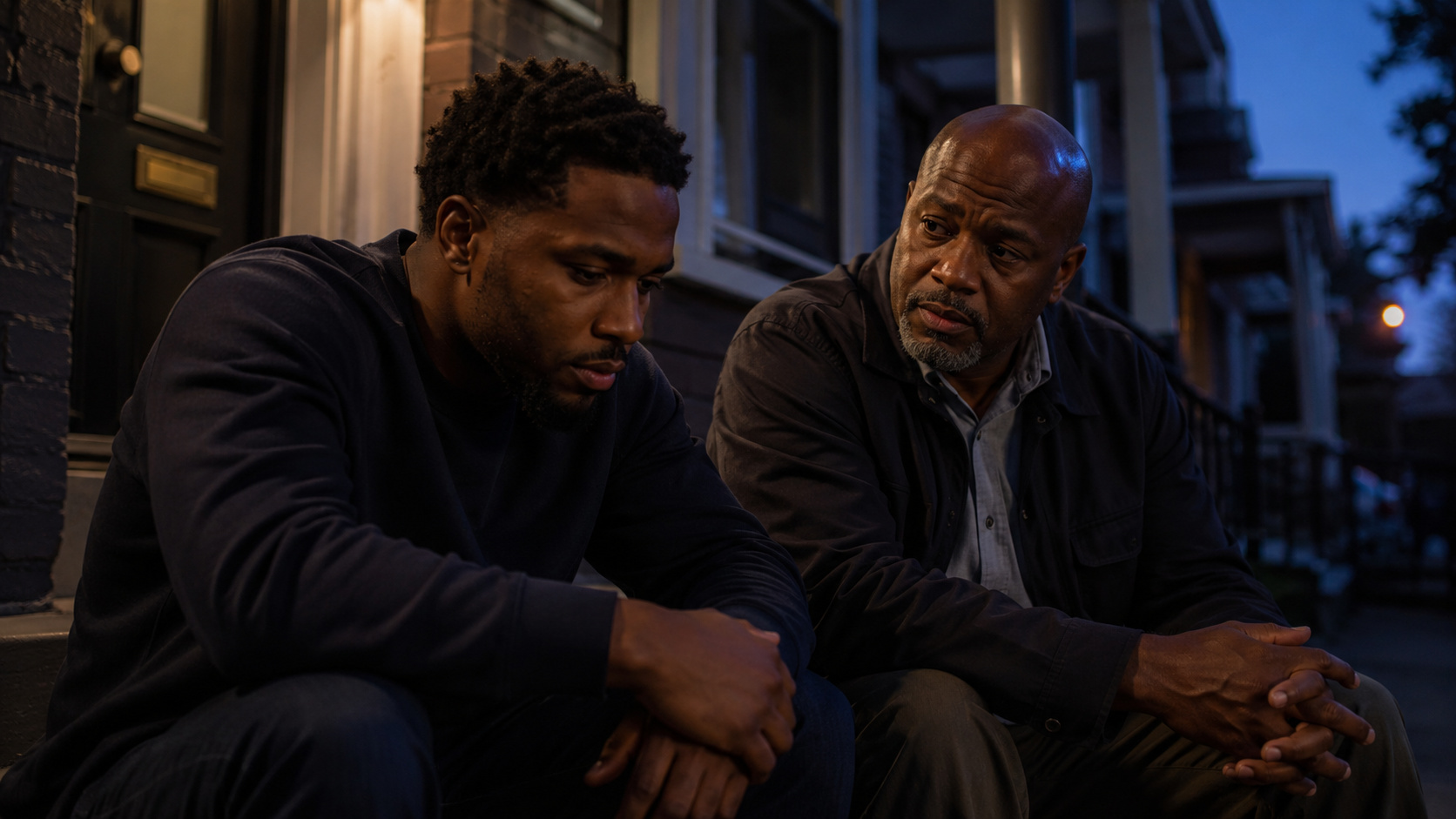
He sat in the center of a room full of families. Children moved between tables. Adults traded updates, advice, schedules, food, and reassurance. Nobody would have described the gathering as lonely. Yet the open chair across from him held the most honest fact in the building: no one had arrived to ask what carrying everyone else had cost him.
Fathers answer questions all day.
Did you make the payment? Did you confirm the pickup? Did you call the school? Did you pack the medicine? Did you fix the car? Did you handle the appointment? Is your child okay? Is the family okay?
The questions are often necessary. Together, they reveal an arrangement. Dad remains visible as a function long after he becomes invisible as a person.
That invisibility exists inside a documented national crisis of parental strain. In 2023, 33% of parents reported high levels of stress in the previous month, compared with 20% of other adults. Nearly half of parents—48%—said their stress felt completely overwhelming on most days, compared with 26% of other adults.1
Yet the broad category of parent can conceal as much as it reveals. It does not tell us who gets asked about mental health. It does not tell us whose symptoms are recognized. It does not tell us whether the father in the pediatric waiting room is treated as a parent who may need care or merely as transportation, insurance information, emergency contact, income, discipline, and support for everyone else.
A man can occupy the center of a family while remaining outside its circle of care.
The center is not the same as the circle
Families often organize themselves around what a father can do. His labor may stabilize the household. His income, transportation, discipline, protection, scheduling, repairs, caregiving, and problem-solving can make him central to daily life. But functional centrality does not guarantee emotional inclusion.
A person can occupy the middle of a system without belonging to its circle of care. The father at the center may be the person everyone calls, yet have no one he trusts enough to call. He may be praised as dependable while learning that the price of dependability is never appearing to need anything.
That arrangement can survive for years because usefulness often conceals distress. The father continues working. He keeps the children safe. He attends the event. He handles the bill. He answers, “I’m good,” because the conversation rarely creates room for a different answer.
The same behavior a family calls dependability may be the behavior keeping a father’s depression invisible.
The weight in numbers
Paternal distress is too common to remain institutionally incidental.
of U.S. parents reported high stress in the previous month.
said stress was completely overwhelming on most days.
paternal perinatal depression across major pooled analyses.
of fathers of one-year-olds screened positive in a large U.S. study.
Interpretation: These figures come from different populations, time frames, and measures. Together, they establish scale—not a diagnosis for any individual father.
Sources: U.S. Surgeon General, 2024; Paulson and Bazemore, 2010; Cameron et al, 2016; Davis et al, 2011.
Pressure does not always look like panic
Public understanding of mental-health crisis remains too dependent on visible collapse. We look for tears, missed work, disorganization, dramatic withdrawal, or unmistakable despair. Many fathers do not present that way. Distress may appear as irritability, overwork, silence, sleep disruption, emotional narrowing, increased substance use, constant motion, or the inability to imagine any role beyond responsibility.
The father who says little may be viewed as stable. The father who keeps moving may be viewed as strong. The father who never asks for help may be admired for carrying the very burden that is quietly injuring him.
These signs are neither unique to fathers nor diagnostic by themselves. Their meaning lies in change: what is new, worsening, persistent, impairing, or dangerous.
Social expectations complicate recognition. Some men do not describe themselves as depressed because sadness is not the symptom they notice first. They notice their temper. Their sleep. Their drinking. Their inability to concentrate. Their withdrawal from touch, conversation, or play. By the time the language of depression becomes available, the consequences may already be visible elsewhere.
Figure 1
The Difference Between Having People and Having Support
Social proximity becomes protective only when a father can safely use the relationships and systems around him.
A social network may provide
- People nearby
- Frequent interaction
- Shared activities
- Family roles
- Professional contacts
- Community visibility
A circle of care must provide
- Safe disclosure
- Knowledge of warning signs
- Specific practical help
- Confidential screening
- Clinical escalation
- Follow-up after crisis
Source note: Conceptual synthesis developed for KonCite from social-support, help-seeking, paternal mental-health, and healthcare-access literature. This is not a validated clinical scale.
Depression was never only a maternal story
The foundational 2010 meta-analysis of prenatal and postpartum depression in fathers pooled 43 studies involving more than 28,000 participants and estimated a prevalence of 10.4% from the first trimester through one year after birth. The highest estimate appeared between three and six months postpartum. The study also found that paternal and maternal depression were correlated.2
An updated meta-analysis later estimated overall paternal depression prevalence at 8.4% across pregnancy and the first postpartum year, again showing that prevalence changes with timing, location, measurement, and study design.3
Even the more conservative estimate approaches one father in twelve. The earlier pooled estimate approaches one in ten. Those ratios represent fathers moving through prenatal visits, delivery rooms, pediatric offices, workplaces, churches, schools, and family gatherings while remaining largely outside the formal architecture of parental mental-health care.
A large U.S. study of fathers of one-year-old children found that approximately 7% screened positive for major depression. Fathers who screened positive reported less frequent reading and more frequent spanking. The finding should not become another indictment of fathers. It should become an argument for reaching them earlier.4
Depression does not remain politely contained inside the person experiencing it. It can enter sleep, patience, attention, play, discipline, communication, partnership, and the ability to remain emotionally available.
Children do not inherit a predetermined future because a father becomes depressed. But they do live inside the emotional weather depression can create: reduced engagement, disrupted routines, marital conflict, irritability, emotional absence, and the loss of ordinary moments through which safety and attachment are built.5
Table 1
The Scale and Meaning of the Evidence
The findings justify action. Their limitations also define the research agenda.
| Finding | Population or evidence | What it means | What it does not mean |
|---|---|---|---|
| 33% reported high stress | U.S. parents, 2023 | Parent stress exceeds that of other adults | Every stressed parent has a mental disorder |
| 48% reported overwhelming stress most days | U.S. parents, 2023 | Pressure is frequent and consequential | The figure applies identically to mothers and fathers |
| ≈8–10% paternal perinatal depression | Major meta-analyses | Paternal depression affects a substantial minority | One estimate applies to every setting or life stage |
| ≈7% screened positive | U.S. fathers of one-year-olds | Depression exists in ordinary pediatric-family populations | Screening alone establishes a clinical diagnosis |
| Parenting behaviors differed by depression status | U.S. observational study | Symptoms may enter parenting interactions | Depression defines a father’s character |
| Child outcomes are associated with paternal distress | Systematic reviews and pooled evidence | Father mental health belongs inside family health | A diagnosis determines a child’s future |
What to notice: Evidence can be strong enough to demand intervention while still requiring careful interpretation, better father-specific measures, and more U.S. research beyond the perinatal period.
Sources: U.S. Surgeon General; Paulson and Bazemore; Cameron et al; Davis et al; Sweeney and MacBeth.
A network is not a safety net
Social support is often discussed as though it can be measured by counting people. How many relatives live nearby? How often does the father see friends? Is he married? Does he attend church? Does he have coworkers? Those questions establish social proximity. They do not establish whether he can safely tell the truth.
A father may have friends with whom he shares sports, work, humor, childhood, travel, alcohol, or routine. He may still have no practiced vocabulary for hopelessness, fear, medication, therapy, suicidal thinking, or the belief that his family would be better without him.
Some fathers concentrate nearly all emotional disclosure inside an intimate partnership. When that relationship fractures, the father may lose the relationship, his primary confidant, daily contact with his children, familiar housing, shared friendships, and the ordinary routines through which he understood himself—all at once.
Support becomes protective only when it is available, trusted, usable, and matched to the need. Encouragement cannot house a father facing eviction. A resource list cannot schedule the appointment. A peer group cannot safely substitute for emergency response. Therapy alone cannot solve every financial, legal, transportation, employment, or childcare barrier that keeps a father from entering treatment.
Support fails when it is emotionally kind but practically irrelevant. It also fails when it is clinically sophisticated but unreachable.
Table 2
Support Must Match the Weight
Precision is part of compassion. Different conditions require different kinds of response.
| Father’s condition | Weak response | Useful psychosocial response | Escalation |
|---|---|---|---|
| High ordinary stress | “Hang in there.” | Meal, childcare, sleep support, scheduled check-in | Screen if persistent |
| Isolation | “Call me sometime.” | Recurring group or direct weekly contact | Assess depression |
| Depressive symptoms | Motivational advice | Screening, therapy access, navigation | Clinical assessment |
| Divorce or reduced child contact | Generic parenting slogans | Grief support, continuity planning, practical resources | Evaluate safety and impairment |
| Employment and financial strain | Therapy alone | Benefits, housing, food, legal, and workforce navigation | Multisystem support |
| Anger and emotional flooding | Shame or punishment | Regulation skills, safety planning, clinical assessment | Immediate action if danger exists |
| Suicidal thoughts | Peer discussion alone | Direct questioning, crisis protocol, warm handoff | 988 or emergency response as appropriate |
Verdict: The father who needs housing cannot be housed with empathy. The father in acute danger cannot be protected by a discussion group. The father who is isolated may not need hospitalization. Precision is part of compassion.
We screen the family around him
Healthcare and social-service systems frequently encounter fathers without treating them as people who might also need care. A father may sit through prenatal visits, pediatric appointments, school meetings, custody proceedings, disability evaluations, or family emergencies while the system directs nearly every meaningful question toward someone else.
He becomes transportation, insurance information, emergency contact, historian, observer, or support person. Rarely does someone pause and ask: How are you sleeping? Are you frightened? Are you becoming isolated? Do you feel safe with yourself? Who checks on you when the children are not in the room?
Research with fathers has found that some men question whether their distress is legitimate, minimize symptoms, or understand available services as designed principally for mothers. A service may technically permit fathers while still communicating that it was not built with them in mind.6
Men notice the forms, the imagery, the waiting-room language, the questions clinicians ask, and the questions no one asks. Inclusion is not achieved because a father is allowed to sit in the room. It is achieved when the room knows he may also need care.
The omission is not neutral. It teaches men that the family’s health matters while their own suffering is peripheral.
Figure 2
How Pressure Becomes Crisis When Support Cannot Be Used
Crisis may be the final visible stage of a long period during which distress remained functional enough to escape recognition.
When the support system leaves with the relationship
Divorce does not produce one universal paternal experience. It can nevertheless remove several protective structures at the same time.
The relationship may end, but so may the father’s principal confidant, ordinary contact with his children, familiar home, shared social network, daily routines, financial predictability, and confidence in the future. Grief, identity injury, legal uncertainty, housing disruption, sleep loss, and reduced child contact can converge while the father is still expected to remain controlled, productive, and reassuring to everyone else.
Researchers frequently aggregate divorced men, separated men, unmarried men, nonresident fathers, and men without children. The literature therefore recognizes relationship dissolution as a mental-health stressor while often failing to isolate the distinctive psychosocial experience of fathers.
Evidence also shows that father-specific interventions after divorce can strengthen parenting and improve child outcomes. In a randomized trial of 384 divorced or separated fathers, a ten-session program produced positive effects on parenting and, at ten months, reductions in child internalizing problems and improvements in social competence.7
That study does not prove that one curriculum solves paternal depression. It proves something important about design: fathers can be engaged in structured, father-specific programming, and the effects can extend beyond the father to the child.
Not every father can disclose distress at the same cost
The language of vulnerability becomes dishonest when it ignores the consequences attached to who becomes vulnerable, before whom, and inside which institution.
For some fathers, disclosure may feel capable of affecting employment, professional credibility, custody, community standing, immigration security, intimate relationships, or how an institution interprets anger, fatigue, and fear. Material conditions shape whether a father can miss work, afford treatment, obtain transportation, arrange childcare, find a culturally credible provider, or wait months for an appointment.
Black fathers do not disclose distress inside a neutral social world. They do so inside institutions that may already read them as dangerous, absent, irresponsible, emotionally excessive, or insufficiently compliant. Asking for vulnerability without addressing surveillance and consequence is not an invitation. It is an exposure.
The same problem appears in different forms for immigrant fathers, veterans, rural fathers, fathers returning from incarceration, fathers with disabilities, fathers caring for children with complex needs, LGBTQ+ fathers, low-income fathers, and men working in professions where weakness is treated as operational risk.
Vulnerability is not equally priced. A credible support system must reduce the price.
The difference between being loved and being reachable
I did not arrive at this work because fatherhood was an abstract research category. I arrived after learning how quickly a man can move from carrying a family to believing he no longer has a legitimate place inside it.
During a period of profound personal and family disruption, I experienced severe depression and survived a suicide attempt. I was loved. I had education. I understood healthcare. I had people whose lives were connected to mine. None of those facts, by themselves, created a usable pathway through the most dangerous hours.
Following the attempt, members of Prince George’s County’s Rapid Response Unit came to my home. That detail matters. At a moment when I could not organize the entire architecture of rescue for myself, support crossed the distance. Someone entered the real environment in which the crisis had occurred.
I did not need another definition of depression. I needed practical help for the next hour, language for what had happened, a pathway toward care, and people prepared to remain after the visible emergency passed.
Recovery taught me that being loved and being reachable are not the same. A person can be surrounded by people who desperately want him alive while still lacking a system designed to recognize what danger looks like, enter it early, and carry part of the administrative and emotional burden of survival.
That understanding became part of the foundation for The Dad Project.
Figure 3
The Psychosocial Support Architecture Fathers Need
No single relationship or intervention should be expected to carry the full burden of recovery.
Recognition
Someone notices changes and asks directly.
Belonging
Recurring peer and community connection.
Practical relief
Food, transportation, childcare, housing, and employment help.
Clinical access
Screening, therapy, psychiatry, and crisis response.
Father-child connection
Routines, coaching, family experiences, and continued presence.
Follow-through
Warm handoffs, reminders, navigation, and repeated contact.
Source note: KonCite synthesis of social-support, integrated-care, peer-support, fatherhood-intervention, and care-navigation literature.
Practice framework
What a Real Circle of Care Requires
Trust does not emerge because a program asks men to be vulnerable. It emerges when the environment reduces risk, offers practical value, and proves that honesty will lead somewhere useful.
A credible reason to gather
Meals, activities, workshops, or family events lower the social cost of entering the room.
Peers who listen
Conversation cannot become competition, correction, performance, or unsolicited preaching.
Practical tools
Support must address the next real problem—sleep, work, housing, transportation, parenting, or safety.
A clinical backbone
Screening, referral, crisis response, and professional partnerships must support peer connection.
Continuity
Repeated contact and a place to return turn one meaningful conversation into infrastructure.
Family dignity
Supporting fathers should strengthen families without treating men as problems or accessories.
The table after fathers arrive
The answer to the first image is not a room in which everyone suddenly focuses on one man. The answer is reciprocity.
At the final table, one father speaks while another listens. A child plays nearby. Someone asks a question without trying to dominate the answer. The men are not performing wellness. They are practicing connection. The father who carried everyone is permitted, perhaps for the first time in a long time, to be carried for part of the evening.
This is what community should make possible: not permanent dependence, not public confession, and not the replacement of clinical care—but a reliable interruption of isolation.

Table 3
From Concern to Infrastructure
Awareness matters only when institutions redesign what happens after concern is expressed.
| Institution | Common response | Structural upgrade | Measure of success |
|---|---|---|---|
| Pediatric care | Focuses on child and mother | Offer father screening and referral | Fathers screened and connected |
| Behavioral health | Waits for self-referral | Community outreach and warm navigation | First appointment attendance |
| County government | Maintains separate directories | Create one father-specific pathway | Referral completion and retention |
| Employer | Offers generic assistance | Father-inclusive leave and protected access | Use without retaliation |
| Community venue | Hosts one awareness event | Recurring Dad Nights and family events | Repeat participation |
| Faith institution | Offers informal counsel | Formal mental-health partnerships | Successful clinical referrals |
| Family and friends | “Call if you need anything” | Direct, scheduled, specific support | Support accepted and sustained |
What to notice: The structural upgrade changes who carries the burden of initiating, navigating, and sustaining support.
A place to arrive before crisis
The Dad Project is one attempt to build that infrastructure. It is a community-based mental-health, connection, and recovery initiative designed so fathers can enter without first performing illness in the correct language.
The model uses accessible Dad Nights in restaurants, recreation centers, libraries, faith spaces, parks, family-friendly venues, and online settings. Fathers share meals, complete brief emotional scans, learn practical regulation and parenting tools, participate in family experiences, and receive navigation to behavioral-health and community resources when additional care is needed.
The program does not treat peer support as therapy. It does not ask restaurants to become clinics. It does not promise that an eight-session curriculum can resolve every mental-health, family, financial, or legal crisis. Its clinical backbone includes screening, risk protocols, referral, warm handoffs, and follow-up.
Individual components draw from established evidence and promising father-specific interventions. The combined Dad Project model remains an evidence-informed local innovation that must be evaluated rather than prematurely declared proven.
The Dad Project does not begin by asking fathers to perform vulnerability. It begins by creating a place where they can arrive.
Institutional decision tool
Five Questions Every Father-Support Initiative Must Answer
Who notices the father before he asks?
Where can he disclose distress without performing or being punished?
Who responds when screening reveals clinical or immediate risk?
Who helps with the practical barriers treatment alone cannot solve?
Who checks again after the meeting, appointment, discharge, or crisis ends?
Use: If an institution cannot answer all five questions, it has concern—not infrastructure.
Leave the chair open
We have spent generations teaching fathers that their value rests in what they can hold together. We build households around their labor, schedules around their availability, emergencies around their response, and identities around their endurance. Then we act surprised when a father disappears inside the structure that depended upon him.
The answer cannot be another campaign telling men to speak. Speech is not the infrastructure.
The infrastructure is the person who notices the silence. The clinic that screens the father rather than merely recording his insurance information. The employer that makes treatment possible without economic punishment. The friend who offers a time, a ride, a meal, and another call tomorrow. The county that connects crisis response to a community a father can return to after the emergency ends. The room where men can arrive through a meal or an activity without first proving that their pain is severe enough to deserve entry.
Fathers do have a responsibility to tell the truth when they can. But institutions have a responsibility to make the truth survivable once it is told.
The father at the center deserves more than praise for carrying the family. He deserves a circle capable of carrying him when the weight becomes too much.
Ask who depends on Dad.
Then ask the question our systems have avoided for too long:
Who has been assigned to support him?
Sources and notes
Evidence Behind the Investigation
Official public-health guidance and peer-reviewed research supporting the article’s discussion of parental stress, paternal depression, family systems, social connection, divorce, and care design.
1Parents Under PressureU.S. Surgeon General advisory · 2024+
U.S. Department of Health and Human Services. Parents Under Pressure: The U.S. Surgeon General’s Advisory on the Mental Health and Well-Being of Parents. 2024.
View source ↗2Prenatal and postpartum depression in fathersJAMA meta-analysis · 2010+
Paulson JF, Bazemore SD. Prenatal and postpartum depression in fathers and its association with maternal depression: a meta-analysis. JAMA. 2010;303(19):1961-1969. doi:10.1001/jama.2010.605
View source ↗3Updated prevalence of paternal depressionJournal of Affective Disorders · 2016+
Cameron EE, Sedov ID, Tomfohr-Madsen LM. Prevalence of paternal depression in pregnancy and the postpartum: an updated meta-analysis. J Affect Disord. 2016;206:189-203. doi:10.1016/j.jad.2016.07.044
View source ↗4Fathers’ depression and parenting behaviorsPediatrics · U.S. study+
Davis RN, Davis MM, Freed GL, Clark SJ. Fathers’ depression related to positive and negative parenting behaviors with 1-year-old children. Pediatrics. 2011;127(4):612-618.
View source ↗5Paternal depression and child outcomesSystematic review+
Sweeney S, MacBeth A. The effects of paternal depression on child and adolescent outcomes: a systematic review. J Affect Disord. 2016.
View source ↗6Fathers’ views of their own mental healthQualitative interview study · 2017+
Darwin Z, Galdas P, Hinchliff S, et al. Fathers’ views and experiences of their own mental health during pregnancy and the first postnatal year. BMC Pregnancy Childbirth. 2017;17:45.
View source ↗7Parenting after divorce and separationRandomized trial · 2018+
Sandler I, Gunn H, Mazza G, et al. Effects of a program to promote high quality parenting by divorced and separated fathers. Prev Sci. 2018;19(4):538-548. doi:10.1007/s11121-017-0841-x
View source ↗8Our Epidemic of Loneliness and IsolationU.S. Surgeon General advisory · 2023+
U.S. Department of Health and Human Services. Our Epidemic of Loneliness and Isolation. 2023.
View source ↗9Depression in parents, parenting, and childrenNational Academies report+
National Research Council and Institute of Medicine. Depression in Parents, Parenting, and Children: Opportunities to Improve Identification, Treatment, and Prevention. 2009.
View source ↗10Adult depression screeningUSPSTF recommendation · 2023+
U.S. Preventive Services Task Force. Screening for Depression and Suicide Risk in Adults. 2023.
View source ↗11Suicide data and preventionCDC official data+
Centers for Disease Control and Prevention. Suicide Data and Statistics.
View source ↗12Suicide and crisis support988 Lifeline+
Substance Abuse and Mental Health Services Administration. 988 Suicide & Crisis Lifeline.
View source ↗13Young fathers and depressive symptomsLongitudinal U.S. study+
Garfield CF, Duncan G, Rutsohn J, et al. A longitudinal study of paternal mental health during transition to fatherhood as young adults. Pediatrics. 2014;133(5):836-843.
View source ↗14Nonresident fathering and child well-beingMeta-analysis+
Adamsons K, Johnson SK. An updated and expanded meta-analysis of nonresident fathering and child well-being. J Fam Psychol. 2013;27(4):589-599. doi:10.1037/a0033789
View source ↗15Prince George’s County behavioral healthOfficial local resource+
Prince George’s County Health Department. Behavioral Health Services.
View source ↗Editorial note: Population-level evidence does not diagnose an individual father. Screening, treatment, and safety decisions should be individualized by qualified professionals. Perinatal findings should not be generalized to all fathers across the life course without qualification.
SEEN AS DANGEROUS,MISSED AS DEPRESSED
Black male pain is often recognized only after it becomes disruptive, dangerous, or fatal. This investigation examines rising suicide among Black men and boys, double consciousness, racialized misdiagnosis, firearm lethality, and why prevention must normalize both psychotherapy and psychiatry—not force people to choose between them.
KonCite · Black Mental Health Investigation
Seen as Dangerous, Missed as DepressedThe Rising Suicide Crisis Among Black Men and Boys—and the Care We Have Failed to Normalize
Black male distress is often recognized only after it frightens, disrupts, or inconveniences someone else. By then, the boy has become a discipline problem, the man has become a threat, and the illness has been allowed to deepen in plain sight.
Content note: This article discusses suicide and psychiatric crisis. In the United States, call or text 988 for immediate crisis support. If someone has an active plan or cannot remain safe, stay with them and seek emergency help.
THE PAIN WE KEEP MISNAMING
We have become very good at recognizing Black male pain when it becomes inconvenient to somebody else.
A boy stops turning in assignments, and the school records noncompliance. He becomes irritable, and adults call him disrespectful. He leaves the basketball team, stops answering friends, sleeps through the afternoon, gives away something he once treasured, or begins taking risks that do not resemble the child his family knows. The adults around him may see attitude, laziness, defiance, hormones, marijuana, bad friends, or a discipline problem.
What they may not see is depression.
A Black man arrives late, misses deadlines, drinks more, drives too fast, stops returning calls, becomes impossible to reach emotionally, or starts speaking about himself as though his existence has become a debt everyone else must pay. His family may call him distant. His supervisor may call him unreliable. The emergency department may call him agitated. Police may call him dangerous.
What they may not call him is ill.
That failure of recognition sits at the center of the rising suicide crisis among Black men and boys. The crisis is not simply that more Black males are experiencing despair. The crisis is that their despair is often forced to travel through institutions trained to interpret Black male behavior before they investigate Black male suffering.
We see the conduct. We miss the condition.
We document the disruption. We fail to diagnose the distress.
And then, after a death, we search backward through the silence and suddenly discover all the signs we had previously renamed.

KonCite Critical Finding
The rate is rising. Recognition and care have not kept pace.
Black men die by suicide at roughly four times the rate of Black women.
Sex differences in method lethality, treatment contact, substance use, isolation and help-seeking all matter. The ratio describes mortality—not who suffers more.
Reported suicide attempts among Black high-school students rose from 1991 through 2017.
The nationally representative analysis found a significant upward trend among Black adolescents while trends were flat or declining in several other groups.
Black children ages 5–12 had a higher suicide death rate than White children in a major national study.
The finding overturned assumptions that very young Black children were relatively protected from suicide mortality.
Firearm-suicide rates among Black teenagers surpassed those among White teenagers.
Because firearms are highly lethal, safe storage and temporary separation during crisis are clinical prevention—not political decoration.
THE NUMBERS ARE NOT THE EXPLANATION
Numbers can identify a crisis without explaining it.
The 73 percent increase in self-reported attempts among Black high-school students from 1991 through 2017 is not a diagnosis of Black adolescence. The higher suicide rate found among Black children ages five through twelve is not evidence of some new defect in Black childhood. The fourfold mortality difference between Black men and Black women does not mean Black women experience less suffering. Each statistic describes a different population, measure, time period, and route to death.
Together, however, they destroy a dangerous myth: that suicide is principally a White problem and that Black families are protected by resilience, spirituality, toughness, or familiarity with adversity.
Resilience is not a psychiatric diagnosis. Faith is not immunity. Strength is not the absence of major depression, bipolar disorder, psychosis, traumatic stress, addiction, or suicidal thinking.
When we romanticize Black survival, we can become less curious about Black suffering. We praise endurance so enthusiastically that we forget endurance has a physiological and psychological cost. We repeat that Black people have survived slavery, segregation, racial terror, poverty, policing, and exclusion—as though historical exposure to suffering should produce permanent resistance to despair.
That is not admiration. It is abandonment dressed as praise.
Sean Joe’s scholarship has been essential because it insists that Black suicide be studied on its own terms rather than treated as a statistical afterthought. Michael Lindsey and colleagues showed that the trajectory among Black adolescents was changing. Arielle Sheftall and colleagues disrupted the belief that very young Black children were comparatively protected. Rheeda Walker’s work has examined how racial stress, psychological fortitude, and culture shape suicide risk and protection among Black Americans.
These scholars did more than add Black faces to an existing literature. They forced the field to ask whether its theories, measurements, screening practices, and clinical assumptions were capable of recognizing Black distress before death made the evidence impossible to ignore.
How suffering becomes a behavior problem
Pain accumulates
Loss, racism, humiliation, violence, family instability, illness, isolation or psychiatric symptoms.
Distress changes behavior
Withdrawal, irritability, substance use, declining performance, agitation or risk-taking.
Institutions rename it
Defiance, laziness, danger, disrespect, poor character or criminality.
Punishment replaces assessment
Suspension, exclusion, police contact, workplace discipline or family conflict.
The illness deepens unseen
Less trust, less disclosure, less treatment and greater risk during crisis.
DOUBLE CONSCIOUSNESS INSIDE THE CLINICAL ENCOUNTER
W. E. B. Du Bois gave us language for the psychic labor of seeing oneself through one’s own eyes and through the gaze of a society that has already decided what Blackness means. Double consciousness is often taught as an elegant theory of identity. It is also a practical problem inside mental healthcare.
Before some Black men describe their pain, they conduct an internal risk assessment.
Will honesty make me look weak?
Will anger make them afraid of me?
Will they call police?
Will this enter my employment record?
Will medication change who I am?
Will the clinician understand racism as an exposure without deciding that race explains everything?
Will I be heard as a person in pain—or processed as a Black man who might become dangerous?
Frantz Fanon, who was both a psychiatrist and an anticolonial theorist, understood that racial domination enters the psyche. He refused the convenient fiction that mental illness exists outside history. Ralph Ellison’s language of invisibility helps explain how a person can be observed constantly while remaining unseen. James Baldwin understood what it costs to live inside other people’s distortions. bell hooks wrote against the emotional mutilation required by narrow forms of masculinity and insisted that love, accountability and emotional truth belong in any serious discussion of Black male life.
These literary voices should not be used as decorative quotations around a clinical article. They identify the social conditions under which disclosure occurs.
A Black man does not enter the therapy room as a brain detached from history. A Black boy does not enter a psychiatric assessment without prior experiences of school discipline, adultification, surveillance, or having his emotions interpreted as threat.
Clinical competence therefore requires more than cultural warmth. It requires diagnostic precision, knowledge of racism-related stress, awareness of differential punishment, careful assessment of substance use and trauma, and enough humility to ask what the patient believes will happen if he tells the truth.

WHY BLACK BOYS ARE PUNISHED BEFORE THEY ARE ASSESSED
Black boys often encounter systems that are exceptionally prepared to manage their behavior and remarkably unprepared to investigate its meaning.
A child who becomes withdrawn may disappear academically without creating enough disruption to trigger concern. A child whose depression appears through anger or impulsivity may receive immediate attention—but the attention may arrive through discipline rather than care. The same distress that might invite evaluation in another child can invite exclusion, suspension, security, or police contact in a Black boy.
This does not mean every episode of misconduct is psychiatric illness. It means that behavior should not be treated as proof that no illness exists.
Depression in boys and men may include sadness, but it can also involve irritability, emotional numbness, reckless behavior, substance use, sleep changes, social withdrawal, declining performance, hopelessness, shame, physical complaints, and a growing belief that one’s family would be better off without them. Bipolar disorder may involve periods of depression alongside decreased need for sleep, unusual energy, impulsivity, grandiosity or agitation. Psychosis may involve hallucinations, paranoia, disorganization or severe changes in functioning. Trauma may appear as vigilance, anger, dissociation, nightmares or avoidance.
The correct response is not to diagnose every difficult Black boy from a distance. It is to build pathways that allow concerning change to produce assessment rather than automatic punishment.
A school should know who performs suicide screening. A pediatric practice should know how to ask directly. A family should know that sudden improvement after severe distress can sometimes reflect a dangerous decision rather than recovery. Coaches, barbers, fraternity brothers, pastors and mentors can become bridges to care—but they should not be turned into unpaid substitutes for trained clinicians.
Community trust matters. Clinical skill matters. Both must be present.
THERAPY IS NOT PSYCHIATRY — AND WE NEED BOTH
For years, public conversation has used “therapy” as shorthand for all mental healthcare. That shorthand is no longer adequate.
Psychotherapy is treatment delivered through structured psychological and behavioral methods. Depending on licensure and training, it may be provided by psychologists, clinical social workers, professional counselors, marriage and family therapists, and psychiatrists. Therapy can help people process trauma, challenge hopeless beliefs, regulate emotion, repair relationships, reduce avoidance, build coping skills and develop a safety plan.
Psychiatry is a medical specialty. Psychiatrists are physicians. They assess psychiatric symptoms alongside medical illness, medications, sleep, substance use and neurological or endocrine contributors. They diagnose mental disorders, evaluate suicide risk, prescribe and monitor psychiatric medication, coordinate hospitalization when necessary, and may also provide psychotherapy.
Neither discipline should be presented as the morally superior form of care.
Some people need psychotherapy without medication. Some need medication and psychotherapy. Some need a psychiatric evaluation because the depression is severe, recurring or accompanied by psychosis, mania, catatonia, dangerous agitation, substance withdrawal, profound insomnia, or persistent suicidal intent. Some need medical testing because thyroid disease, medication effects, sleep disorders, neurological illness, chronic pain or substance use may be affecting mood and cognition.
Medication is not a spiritual failure. It is not proof that the family did not pray hard enough. It is not a surrender of Black strength.
Medication is also not magic. It cannot make an unsafe school safe. It cannot remove racism from a workplace. It cannot build a trustworthy relationship with a father. It cannot substitute for housing, food, sleep, belonging, grief support or protection from violence.
The point is not to choose between therapy and psychiatry.
The point is to stop offering partial care to people facing potentially fatal illness.
THERAPY IS NOT PSYCHIATRY — AND WE NEED BOTH
For years, public conversation has used “therapy” as shorthand for all mental healthcare. That shorthand is no longer adequate.
Psychotherapy is treatment delivered through structured psychological and behavioral methods. Depending on licensure and training, it may be provided by psychologists, clinical social workers, professional counselors, marriage and family therapists, and psychiatrists. Therapy can help people process trauma, challenge hopeless beliefs, regulate emotion, repair relationships, reduce avoidance, build coping skills and develop a safety plan.
Psychiatry is a medical specialty. Psychiatrists are physicians. They assess psychiatric symptoms alongside medical illness, medications, sleep, substance use and neurological or endocrine contributors. They diagnose mental disorders, evaluate suicide risk, prescribe and monitor psychiatric medication, coordinate hospitalization when necessary, and may also provide psychotherapy.
Neither discipline should be presented as the morally superior form of care.
Some people need psychotherapy without medication. Some need medication and psychotherapy. Some need a psychiatric evaluation because the depression is severe, recurring or accompanied by psychosis, mania, catatonia, dangerous agitation, substance withdrawal, profound insomnia, or persistent suicidal intent. Some need medical testing because thyroid disease, medication effects, sleep disorders, neurological illness, chronic pain or substance use may be affecting mood and cognition.
Medication is not a spiritual failure. It is not proof that the family did not pray hard enough. It is not a surrender of Black strength.
Medication is also not magic. It cannot make an unsafe school safe. It cannot remove racism from a workplace. It cannot build a trustworthy relationship with a father. It cannot substitute for housing, food, sleep, belonging, grief support or protection from violence.
The point is not to choose between therapy and psychiatry.
The point is to stop offering partial care to people facing potentially fatal illness.
Mental healthcare is an ecosystem
| Professional or service | Primary role | What they may provide | When especially important |
|---|---|---|---|
| Psychiatrist | Medical diagnosis and treatment | Psychiatric assessment, medication, medical differential diagnosis, hospitalization decisions, psychotherapy in some practices | Severe depression, bipolar disorder, psychosis, complex medication needs, persistent or acute suicide risk |
| Psychologist | Psychological assessment and psychotherapy | Evidence-based therapy, testing, diagnostic assessment, suicide-focused treatment | Trauma, depression, anxiety, behavioral concerns, cognitive or personality assessment |
| Clinical social worker or counselor | Psychotherapy and care navigation | Therapy, family work, crisis support, resource coordination | Ongoing treatment, relational stress, grief, trauma and system navigation |
| Primary-care or pediatric clinician | Front-door screening and medical assessment | Depression and suicide screening, initial medication in some cases, labs, referrals and follow-up | New symptoms, physical complaints, sleep change, medication or medical contributors |
| Emergency or crisis service | Immediate safety assessment | Acute evaluation, stabilization, safety planning, hospitalization or urgent referral | Active plan, intent, recent attempt, psychosis, inability to remain safe |
| Family, peers, faith and community | Connection and practical support | Presence, transportation, monitoring, encouragement, help following the safety plan | Every stage—but never as a substitute for clinical care during psychiatric crisis |
MEDICATION WITHOUT SHAME — AND WITHOUT MYTH
Black communities have good historical reasons to be cautious about medicine. Distrust did not fall from the sky. It was produced by unequal treatment, coercion, experimentation, dismissal, misdiagnosis and systems that have often been more willing to control Black behavior than relieve Black suffering.
That history must be acknowledged. It must not become a reason to abandon people who may benefit from psychiatric treatment.
Antidepressants, mood stabilizers, antipsychotic medications, medications for anxiety, and treatments for substance-use disorders are different classes with different indications, benefits, side effects and monitoring requirements. The correct question is not “Do you believe in medication?” as though pharmacology were a denomination.
The questions are clinical:
What symptoms are present?
How severe are they?
What diagnosis or diagnoses best explain them?
What medical conditions or substances could be contributing?
What treatment has been tried?
What are the benefits, risks, alternatives and monitoring plan?
For young people, treatment requires particular care. Medication decisions should involve development, family history, symptom course, safety monitoring and clear follow-up. Families should understand what changes require urgent contact. Medication should not be prescribed casually, and fear of medication should not block indicated care.
We should normalize psychiatric consultation without normalizing careless prescribing.
We should normalize medication without promising that medication alone can repair social injury.
We should normalize second opinions, questions, monitoring and patient autonomy.
Complete care is neither anti-medication nor medication-only. It is precise enough to use every appropriate tool and humble enough to recognize the limits of each one.
THE FIREARM QUESTION
Any honest investigation of Black male suicide must address firearms.
This is not because every suicidal person uses a firearm. It is because firearms are highly lethal, suicide crises can escalate rapidly, and the difference between immediate access and temporary distance can determine whether a person survives long enough for the crisis to change.
Among Black males, firearms are a leading method of suicide death. Recent youth trends make the issue more urgent. When firearm-suicide rates among Black teenagers surpassed those among White teenagers, the finding should have changed how families, clinicians, schools and community organizations discussed safe storage.
Safe storage means more than hiding a weapon. It may involve locked storage, unloaded storage, ammunition stored separately, and preventing access to keys or combinations. During a period of elevated risk, the safest arrangement may be temporary lawful storage away from the person in crisis, consistent with local law and professional guidance.
The purpose is not punishment. The purpose is time.
Suicidal intensity can change. A person may feel unable to survive an hour and feel differently after sleep, connection, treatment, medication, removal from conflict, sobriety, or simply the passage of time. A highly lethal method collapses the distance between impulse and death.
Lethal-means counseling is therefore not ideological theater. It is survival architecture.
Suicide prevention must be a pathway, not a referral
Withdrawal, agitation, hopelessness, sleep change, substance use, giving possessions away or speaking as a burden.
Ask about suicidal thoughts, plan, intent, timing and access to lethal means.
Stay present, remove lethal access, involve trusted people and use crisis services.
Psychiatric, psychological, medical, substance-use and family assessment as indicated.
Therapy, medication, hospitalization, safety planning, sleep and substance treatment according to need.
Rapid appointments, caring contacts, family support and repeated reassessment.
WHAT ACTUALLY PREVENTS SUICIDE
Suicide prevention is often reduced to awareness. Awareness matters, but awareness without an operating system leaves families informed and alone.
Evidence supports several concrete practices.
Direct questioning matters. Asking whether someone is thinking about suicide does not create suicidal thinking. It can reduce ambiguity and permit a more accurate assessment of risk.
Safety planning matters. The Stanley-Brown Safety Planning Intervention helps a person identify warning signs, internal coping strategies, people and places that provide distraction, individuals who can help, professional resources, and steps to make the environment safer. In a large emergency-department study among veterans, safety planning combined with structured follow-up was associated with fewer suicidal behaviors and greater treatment engagement than usual care.
Follow-up matters. Risk does not end when the emergency department discharges someone or the inpatient unit closes the chart. The days and weeks after a crisis require rapid appointments, caring contacts, medication follow-up where relevant, family education and clear instructions for what to do if risk returns.
Suicide-focused psychotherapy matters. Cognitive therapy and cognitive-behavioral approaches can directly address suicidal beliefs, hopelessness, problem solving and relapse prevention. Dialectical Behavior Therapy has strong evidence for reducing suicidal and self-harming behavior in appropriate populations. Treatment should not assume that improving a general diagnosis automatically resolves suicide risk.
Psychiatric treatment matters. Severe mood disorders, psychosis, substance-use disorders and other psychiatric conditions require diagnosis and treatment proportionate to their seriousness. Medication may be part of that treatment. Hospitalization may sometimes be necessary. The goal should be the least restrictive care that can reliably maintain safety—not avoidance of psychiatry until the crisis becomes unmanageable.
Connection matters, but connection must be operational. “Call me anytime” is less useful than agreeing who will stay tonight, who will hold the car keys, who will store the firearm, who will attend the appointment, who will manage medications, and who will call tomorrow morning.
Cultural responsiveness matters. A clinician does not become culturally competent by displaying a Black poster or saying the word trauma. The patient should not have to teach the provider why racism, adultification, religious language, masculinity, police exposure, financial responsibility or family reputation shapes the way distress is expressed and help is sought.
The strongest prevention plan is not one heroic conversation. It is a coordinated system that remains present after the immediate emotion has passed.
What complete suicide prevention can include
| Intervention | Primary purpose | Evidence-informed benefit | Important boundary |
|---|---|---|---|
| Direct suicide inquiry | Identify ideation, plan, intent and access | Improves disclosure and risk assessment; asking does not create suicidal ideation | Questions must lead to action when risk is present |
| Stanley-Brown safety planning | Create a practical crisis sequence | Associated with reduced suicidal behavior and improved follow-up engagement | Not a “no-suicide contract” and not a substitute for emergency care |
| Lethal-means counseling | Create time and distance from highly lethal methods | Reduces access during periods of acute risk | Must be specific, collaborative and legally appropriate |
| Suicide-focused CBT or cognitive therapy | Address hopelessness, beliefs, problem solving and recurrence | Can reduce repeat attempts in selected patients | Requires trained clinicians and ongoing safety assessment |
| Dialectical Behavior Therapy | Reduce suicidal and self-harming behavior while building regulation skills | Strong evidence in appropriate high-risk populations | Intensive model; availability and fit vary |
| Psychiatric assessment and medication | Treat underlying psychiatric illness and severe symptoms | May reduce depression, mania, psychosis, anxiety or substance-related risk | Requires diagnosis, monitoring, follow-up and informed consent |
| Rapid follow-up and caring contacts | Maintain connection after discharge or crisis | Supports engagement during a high-risk transition period | Must connect to accessible ongoing care |
| Family and school intervention | Reduce conflict, improve monitoring and create support | Can strengthen protective relationships and early recognition | Should protect confidentiality and avoid turning families into clinicians |
WHY “GO TO THERAPY” IS NOT A SYSTEM
“Black men need therapy” has become a culturally acceptable sentence. It is often offered as though it completes the analysis.
Therapy may be exactly what a person needs. It may also be unavailable, unaffordable, poorly matched, insufficiently frequent, culturally unsafe, or clinically incomplete. A weekly appointment cannot compensate for an active plan, a loaded firearm, untreated mania, severe alcohol withdrawal, command hallucinations, or the period immediately after a suicide attempt.
The phrase can also relocate responsibility onto the person in pain. He is told to find a provider, verify insurance, assess cultural fit, take time from work, arrange transportation, explain himself to a stranger, and remain hopeful through waiting lists—all while experiencing the illness that makes executive functioning, trust and hope more difficult.
Normalization must therefore extend beyond encouraging disclosure.
We need to normalize psychiatric evaluation.
We need to normalize medication when clinically indicated.
We need to normalize changing clinicians when care is dismissive or unsafe.
We need to normalize family participation without stripping the patient of dignity.
We need to normalize same-day crisis access, follow-up after discharge, substance-use treatment, sleep evaluation and the removal of lethal means.
We need to normalize asking a successful Black man whether he wants to live—not because he appears unstable, but because achievement has never been proof against despair.
The problem is not that Black men and boys refuse all help.
The problem is that the help presented to them is too often fragmented, culturally thin, administratively exhausting, or activated only after danger becomes visible to everyone else.

HOW TO ASK WITHOUT MAKING HIM PERFORM
The worst questions contain the answer we want.
“You are not thinking about doing something crazy, are you?”
“You would never do that to your mother.”
“You know you have too much to live for.”
Those sentences communicate fear, judgment and obligation. They tell the person that honesty will create a problem for the listener.
Use direct, calm language.
“I have noticed that you have stopped doing things you usually care about, and you sound exhausted. Sometimes when people feel trapped, they think about dying. Has that been happening to you?”
“Are you thinking about suicide?”
“Have you thought about how you would do it?”
“Do you have access to what you would use?”
“Have you decided when?”
“Can you stay with me while we get help?”
Do not debate whether the person has a good life. Do not demand gratitude. Do not ask him to prove love for the family by surviving the moment alone.
If there is an active plan, intent, recent attempt, severe intoxication, psychosis, or access to a lethal method, treat the situation as urgent. Stay present. Engage emergency or crisis services. Reduce access to lethal means. Do not promise secrecy.
The goal is not to deliver a perfect speech.
The goal is to help the person survive long enough for treatment, connection and time to alter what currently feels permanent.
BEYOND SURVIVAL
We have spent too long praising Black men for surviving systems that remain unwilling to care for them.
Survival is not treatment.
Endurance is not wellness.
Silence is not stability.
And a man’s usefulness to his job, family, church, fraternity, team or community is not evidence that he feels attached to his own life.
The intervention cannot begin at the funeral, when everyone suddenly becomes fluent in the language of warning signs. It must begin in pediatric visits, school hallways, locker rooms, barbershops, primary-care offices, emergency departments, psychiatric clinics, workplaces, churches, group chats and family kitchens.
But community presence must connect to clinical capacity.
The barber can notice.
The coach can ask.
The father can stay.
The pastor can accompany.
The friend can hold the keys.
The psychiatrist can assess.
The therapist can treat.
The health system can follow up.
The family can help make the environment safer.
No one person has to become the entire system. Everyone has to know their part.
We should not ask Black boys to become less emotional. We should stop punishing the forms their emotion is allowed to take.
We should not ask Black men to become less strong. We should build a definition of strength large enough to include medication, hospitalization, tears, boundaries, disclosure, rest and the decision to stay alive.
The goal is not to teach Black men and boys how to suffer more quietly.
The goal is to make sure they do not have to suffer alone—and that when they reach for care, the care is complete enough to meet them.
Stay. Ask. Protect. Connect.
If someone tells you he is thinking about suicide, believe the seriousness of the disclosure. Ask about plan, intent and access. Stay with him when danger is immediate. Create distance from firearms and other lethal methods. Connect him to crisis and clinical care—and remain involved after the first appointment.
United States: Call or text 988 for the Suicide & Crisis Lifeline. If there is an active plan, an attempt in progress, severe medical danger or an inability to remain safe, seek emergency assistance immediately.
CALL OR TEXT 988Sources and Notes
Peer-reviewed research, surveillance resources and Black intellectual traditions supporting the article’s analysis of suicide, diagnosis, treatment, double consciousness and culturally responsive care.
01Lindsey MA, Sheftall AH, Xiao Y, Joe S
Lindsey MA, Sheftall AH, Xiao Y, Joe S. Trends of suicidal behaviors among high school students in the United States: 1991–2017. Pediatrics. 2019;144(5):e20191187.
View source ↗02Bridge JA, Horowitz LM, Fontanella CA, et al
Bridge JA, Horowitz LM, Fontanella CA, et al. Age-related racial disparity in suicide rates among US youths from 2001 through 2015. JAMA Pediatrics. 2018;172(7):697-699.
View source ↗03Joe S
Joe S. Explaining changes in the patterns of Black suicide in the United States from 1981 to 2002: an age, cohort, and period analysis. Journal of Black Psychology. 2006;32(3):262-284.
View source ↗04Walker RL, Salami TK, Carter SE, Flowers K
Walker RL, Salami TK, Carter SE, Flowers K. Perceived racism and suicide ideation: mediating role of depression but moderating role of religiosity among African American adults. Suicide and Life-Threatening Behavior. 2014;44(5):548-559.
View source ↗05Lindsey MA, Joe S, Nebbitt V
Lindsey MA, Joe S, Nebbitt V. Family matters: the role of mental health stigma and social support on depressive symptoms and subsequent help seeking among African American boys. Journal of Black Psychology. 2010;36(4):458-482.
View source ↗06Stanley B, Brown GK, Brenner LA, et al
Stanley B, Brown GK, Brenner LA, et al. Comparison of the Safety Planning Intervention with follow-up vs usual care of suicidal patients treated in the emergency department. JAMA Psychiatry. 2018;75(9):894-900.
View source ↗07Brown GK, Ten Have T, Henriques GR, Xie SX, Hollander JE, Beck AT
Brown GK, Ten Have T, Henriques GR, Xie SX, Hollander JE, Beck AT. Cognitive therapy for the prevention of suicide attempts: a randomized controlled trial. JAMA. 2005;294(5):563-570.
View source ↗08Dazzi T, Gribble R, Wessely S, Fear NT
Dazzi T, Gribble R, Wessely S, Fear NT. Does asking about suicide and related behaviours induce suicidal ideation? What is the evidence? Psychological Medicine. 2014;44(16):3361-3363.
View source ↗09Du Bois WEB
Du Bois WEB. The Souls of Black Folk. 1903.
View source ↗10Fanon F
Fanon F. Black Skin, White Masks. 1952.
View source ↗11Ellison R
Ellison R. Invisible Man. 1952.
View source ↗12hooks b
hooks b. The Will to Change: Men, Masculinity, and Love. 2004.
View source ↗13Centers for Disease Control and Prevention
Centers for Disease Control and Prevention. Suicide Data and Statistics. Current surveillance resource.
View source ↗14988 Suicide & Crisis Lifeline
988 Suicide & Crisis Lifeline. Current crisis resource.
View source ↗
You didn’t deserve that
At eight years old, I learned that home could become dangerous without warning. Decades later, becoming the father of two sons forced me to reconsider what happened, what my body carried forward, and why a parent’s refusal to remember does not erase a child’s experience.
This personal investigation moves from childhood abuse and parental addiction to the public-health evidence on adverse childhood experiences, trauma recovery, and intergenerational conditioning. It also examines how survivors can build homes where correction does not become humiliation, authority does not depend on fear, and children never have to become weapons to feel safe.
KonCite · Personal Investigation
You Didn’t Deserve That Decoding Childhood Emotional Abuse After Becoming a Parent
I believed the trauma ended when I stopped being afraid of my father. Becoming the father of two sons taught me that fearlessness and healing are not the same thing—and that childhood abuse is never only a private family matter.
Editorial reconstruction: This conceptual image represents the article’s themes of childhood memory, fatherhood, protection, and the interruption of generational harm. It does not depict the exact historical events described.
The Bathroom Floor
I was eight years old when my father taught me that home could become dangerous without warning.
My mother had left for one of the three jobs she worked to keep our household afloat. I was in my father’s bathroom, standing in front of the medicine cabinet, looking for a Band-Aid. He walked in, saw me there, stood behind me, and slapped me with the full force of a grown man.
My temple struck the bottom corner of the cabinet. I blacked out.
When I regained consciousness, I was alone. He had left me there. I do not remember anyone asking whether I had suffered a concussion. I do not remember him returning in panic, kneeling beside me, or showing horror at what his hand had done. I remember learning that the adult responsible for protecting me could knock me unconscious and walk away.
The physical act lasted seconds. The lesson lasted much longer: danger did not always enter through the front door. Sometimes it already had a key.

Six Months Later, My Mother Left
Approximately six months later, in the middle of a snowstorm, my mother left him. Leaving changed the household, but it did not instantly undo what my body had learned inside it.
The fear had already been installed. Alcohol and drug use remained part of the landscape of my childhood, and his instability continued to cross the boundaries that separation was supposed to create. Years later, when I played high school basketball, he became so intoxicated and disruptive that he was banned from attending my games.
What should have been a place where I searched the stands for a father’s pride became another place where I searched for danger. The abuse had followed me out of the house and into the gymnasium.

I Was Training for War
When I was ten, someone asked what I wanted for Christmas. I said a weight set. I received a Hulk Hogan weight set and began lifting every day.
Most children lift weights because they want to become athletes, imitate a hero, or see muscles forming in the mirror. I was preparing to fight my father.
From ten to thirteen, I trained because I believed childhood survival might eventually require me to overpower a grown man. Every repetition carried a private promise: one day, if he put his hands on me again, I would be strong enough to stop him.
The adaptation made sense inside the environment. The problem was not that the child built strength. The problem was that a child believed becoming a weapon was the only reliable path to safety.

Figure 1
How a Child Adapts to an Unsafe Parent
The adaptation is often an intelligent response to danger. Harm develops when a childhood survival strategy remains active after the original threat has passed.
| Childhood adaptation | Immediate protective function | Possible adult expression | Corrective direction |
|---|---|---|---|
| Hypervigilance | Anticipates unpredictable danger | Scanning rooms, sleep difficulty, rapid conflict activation | Learn present-day safety cues and grounding |
| Emotional suppression | Reduces punishment for showing distress | Detachment, shame, difficulty asking for help | Develop emotional language and safe disclosure |
| Physical preparation | Counters helplessness and vulnerability | Defensiveness, compulsive strength, readiness to fight | Expand safety beyond combat and control |
| Overachievement | Creates predictability and approval | Perfectionism, work addiction, fear of failure | Separate worth from performance |
| People-pleasing | Reduces anger, rejection, or abandonment | Weak boundaries and excessive responsibility | Practice limits without guilt |
| Withdrawal | Reduces exposure and humiliation | Isolation, distrust, emotional distance | Build selective, reciprocal connection |
Interpretation: These patterns are not diagnoses. The same behavior can have many causes, and survivors do not all adapt in the same way.
The Night I Stopped Being Afraid
The moment came during the summer before high school. At approximately 1:30 in the morning, my father dragged me out of bed. He was drunk, raging, and demanding what he called a family meeting. He pulled me through the house and slammed my back into a doorframe.
I bounced forward with my fist closed and my body loaded. Years of fear, weightlifting, humiliation, and preparation gathered behind one arm.
My mother grabbed my arm and said, “No. The Bible says honor your mother and father.”
I answered, “The Bible also says fathers, provoke not your sons.” I knew the Word because I spent so much time inside. Scripture had become one of the few authorities available to me that stood above his anger.
I watched his bloodshot eyes widen. I smelled the liquor on his breath. In that moment, I knew I was no longer afraid of him.
For years, I treated that night as the ending. I believed that once I destroyed the fear, I had destroyed the trauma. I had not. I changed the balance of power between my father and me. I had not yet changed what his violence had taught my body.
I destroyed the fear. I did not destroy the trauma.
Fearlessness Is Not Healing
Trauma is often described through fear because fear is visible. A child trembles, hides, freezes, cries, or avoids. But fear is only one of the ways childhood abuse reorganizes a life.
A child living with an intoxicated, unpredictable, or violent parent does not simply experience isolated incidents. He adapts to an environment. He listens for footsteps, studies facial expressions, tracks the front door, and calculates whether silence will make him safer. Those adaptations can become so practiced that they eventually look like personality.
Hypervigilance may look like exceptional awareness. Emotional suppression may look like maturity. Refusing help may look like independence. Constant preparation may look like discipline. These strategies can protect children inside environments they cannot control, yet the body may continue using them after the original danger has passed.
My story was personal. The pattern was not rare. Adverse childhood experiences include abuse, neglect, household substance misuse, and family instability. Across studies, cumulative exposure is associated with higher odds of depression, suicidality, harmful substance use, interpersonal difficulty, and several chronic health outcomes. These associations do not mean every survivor follows one path. They mean childhood safety is a population-health issue rather than a private family concern.
The bathroom floor does not remain in the bathroom. Schools, clinics, workplaces, relationships, and future families eventually receive the consequences.
Evidence panel
Childhood Abuse Is a Societal Issue
The bathroom floor does not remain in the bathroom. Education, healthcare, employment, relationships, and future families eventually carry the consequences.
| Evidence domain | What the literature shows | Why it matters |
|---|---|---|
| Cumulative exposure | Meta-analyses find progressively higher risks across mental health, substance use, violence, and physical health as adversity accumulates. | Prevention and treatment must address accumulation, not only single incidents. |
| Emotional abuse | Psychological maltreatment is independently associated with depression, anxiety, post-traumatic symptoms, shame, and relational difficulty. | The absence of visible injury does not mean the absence of durable harm. |
| Household substance misuse | Parental alcohol or drug misuse increases unpredictability, impaired supervision, conflict exposure, and maltreatment risk. | Addiction treatment is also child-safety policy. |
| Education | Traumatic stress can disrupt sleep, attention, emotional regulation, attendance, and classroom behavior. | Schools often see the adaptation before anyone names the source. |
| Adult health | Large observational studies associate childhood adversity with later cardiovascular, metabolic, pain, and mental-health burdens. | Childhood protection is a long-term health intervention. |
| Intergenerational risk | Maltreatment can recur across generations, but safe, stable, nurturing relationships and treatment can interrupt transmission. | History changes risk; it does not determine destiny. |
Associations do not mean every survivor develops illness or repeats abuse. Risk is probabilistic, not destiny.
My Sons Reopened the Case
I did not fully understand what had happened to me until I became the father of two sons.
I had always known the facts: the cabinet, the blackout, the liquor, the doorframe, the basketball games, and the years I spent preparing to fight. Parenthood changed the scale of those memories.
When I look at my boys, I see how small children actually are. I see their softness, dependence, humor, confusion, and innocence. Even when they are loud, emotional, disobedient, exhausted, or difficult, I do not stop recognizing them as children. Their behavior does not erase my obligation to regulate mine.
The child I was raising became evidence for the child I had been. I could respond patiently to a mistake and recognize that patience had always been possible. I could apologize after speaking too sharply and recognize that accountability never weakened a parent. I could watch my sons sleep and understand that protection should never have required negotiation.
Parenthood did not create the wound. It removed the explanations that had once concealed its severity.
He Said He Did Not Remember
In my 40s, I finally confronted my father. I wanted acknowledgment. I wanted him to understand that what he may have experienced as intoxicated episodes became the organizing memories of my childhood.
He said he did not remember. He said he had blacked out when he drank. He refused to apologize.
That answer crushed me. I had carried the memories for a lifetime, while he claimed not to carry them at all. He lost the night. I lost the safety. He forgot the blow. I built my body around the possibility of the next one.
Alcohol-related amnesia may explain impaired recall. It does not erase responsibility. A person does not need perfect memory to say: I believe you. I was the adult. You were the child. My intoxication does not excuse what I did. You did not deserve it. I am sorry.
Memory is not the price of admission for remorse. His refusal forced me to accept that healing could no longer depend on his willingness to become the father I needed.
He lost the night. I lost the safety.
You Didn't Deserve That
The title of this piece is not sentimental reassurance. It is a correction of the child’s original logic.
The adult is supposed to love me. The adult is hurting me. A child rarely concludes that the parent lacks sobriety, emotional regulation, judgment, or moral courage. The child is more likely to conclude that something about the child caused the treatment.
This is how abuse migrates from an event into an identity. The parent commits the violence. The child becomes the explanation.
I was eight years old. I was looking for a Band-Aid. He was the adult. His intoxication did not make me responsible. His rage did not prove I was disrespectful. No rule, mistake, Scripture, family hierarchy, or cultural expectation justified rendering a child unconscious and leaving him alone.
Healing begins by returning responsibility to its proper owner.
Table 1
What Emotional Abuse Teaches—and What Healing Must Correct
| Abusive message | What the child may learn | Adult consequence | Corrective truth |
|---|---|---|---|
| “You made me angry.” | I cause other people’s violence. | Excessive guilt and people-pleasing. | Adults are responsible for regulating their behavior. |
| “Stop being weak.” | Emotion invites punishment. | Suppression and shame. | Emotion is information, not failure. |
| “You are disrespectful.” | Disagreement is dangerous. | Conflict avoidance or aggression. | Boundaries and disagreement can remain safe. |
| “No one will believe you.” | Truth is powerless. | Silence and isolation. | Safe witnesses and evidence matter. |
| “I do not remember.” | My memory is unreliable. | Self-doubt and rumination. | Another person’s amnesia does not erase the event. |
| “That was discipline.” | Fear equals respect. | Harsh parenting reflexes. | Discipline teaches; abuse terrorizes. |
What Research Says Helps Adults Heal
Recovery does not require forgetting, minimizing the abuse because the parent struggled with addiction, reconciling with the person who caused harm, or forgiving on someone else’s timetable. It requires treatment that matches the survivor’s symptoms, preferences, culture, relationships, and readiness.
Trauma-focused psychotherapies have the strongest evidence for post-traumatic stress symptoms. Cognitive Processing Therapy helps survivors identify and challenge “stuck points” involving guilt, shame, trust, power, safety, and intimacy. It can address beliefs such as: I should have stopped him; I cannot trust anyone; strength means never needing help; conflict always becomes violence; love requires tolerating harm.
Prolonged Exposure helps survivors gradually approach memories, emotions, and safe situations they have avoided because those reminders trigger distress. The goal is not to force suffering. It is to help the nervous system learn that remembering is not the same as being trapped there again.
EMDR pairs structured trauma recall with bilateral stimulation and can reduce distress attached to traumatic memories. It is supported by major treatment guidelines, although no single approach is universally superior and fit matters.
Skills-based treatment can help with grounding, emotion regulation, sleep, anger, dissociation, and relationship safety. Group therapy and peer support can reduce shame and isolation. Medication may help depression, anxiety, nightmares, sleep disturbance, or PTSD symptoms, but medication does not process the trauma by itself.
Survivors of chronic childhood abuse may need stabilization and trust-building before direct trauma processing. A trauma-informed clinician should understand addiction in family systems, masculinity, race, faith, discipline, and the cultural pressure to convert pain into silence.
Table 2
Evidence-Based Trauma Treatment Options
These approaches should be selected with a qualified trauma-informed clinician according to symptoms, readiness, preferences, culture, and co-occurring conditions.
| Approach | Primary target | What treatment involves | Evidence position | Important limitation |
|---|---|---|---|---|
| Cognitive Processing Therapy | Guilt, shame, trauma beliefs | Structured cognitive work, practice assignments, examination of stuck points | Strong evidence for PTSD | Requires engagement with painful beliefs |
| Prolonged Exposure | Avoidance and fear | Imaginal exposure and gradual return to safe avoided situations | Strong evidence for PTSD | Must be paced and delivered by a trained clinician |
| EMDR | Distressing trauma memories | Structured recall with bilateral stimulation | Guideline-supported | Not every patient prefers or responds to it |
| Skills/stabilization | Dysregulation, sleep, anger, dissociation | Grounding, distress tolerance, emotion regulation, safety planning | Supportive/adjunctive | May not fully process memories alone |
| Group or peer support | Isolation and shame | Shared learning, validation, skills, connection | Helpful for selected patients | Group safety and fit matter |
| Medication | Depression, anxiety, nightmares, sleep or PTSD symptoms | Pharmacologic symptom management | Symptom-specific evidence | Does not process trauma by itself |
This educational table is not individual medical advice. Immediate danger, suicidal thinking, severe substance use, or inability to function requires prompt professional assessment.
Not Every Pattern Is a Generational Curse
I do not believe everything inherited across families is a generational curse. Some things are generational conditioning.
Conditioning is what happens when repeated behavior becomes familiar enough to feel natural: harsh tones inherited as preparation, fear mistaken for discipline, silence mistaken for peace, emotional absence mistaken for masculinity, and the refusal to apologize mistaken for authority.
Calling every pattern a curse can make it sound mystical, fixed, or externally controlled. Conditioning names the learning. What was learned can be identified, interrupted, replaced, and repaired.
I do not need to repeat my father’s tone because I heard it. I do not need to treat fear as respect because fear controlled me. I do not need to make my sons hard by becoming the first thing they must survive.
Figure 2
How a Parent Interrupts Generational Conditioning
Trigger
A child’s behavior activates the parent’s history.
Pause
Notice the body, memory, and urge before acting.
Separate
Identify what belongs to the present child and what belongs to the past.
Respond
Use limits without humiliation, intimidation, or fear.
Repair
Acknowledge harm when the parent gets it wrong.
Repeat
Cycle-breaking becomes a practice, not a declaration.
What Cycle-Breaking Looks Like at Home
Cycle-breaking parents will still become tired, impatient, and imperfect. The distinction is not perfection. It is the willingness to pause, regulate, and repair.
It means asking: Am I responding to my child, or am I responding to what my child awakened in me? It means separating behavior from identity, maintaining limits without humiliation, refusing to use fear as evidence of respect, and allowing boys tenderness without treating emotion as weakness.
It also means apologizing. A parent can say: I was wrong. You did not deserve that tone. The rule still stands, and it was my job to manage my frustration. You are safe with me. We can repair this.
An apology does not surrender parental authority. It shows children that love and accountability can occupy the same room.
When alcohol or drug use is part of the family history, cycle-breaking also requires direct protection: sober caregiving, treatment, boundaries around intoxicated adults, and refusal to let “I do not remember” become the family accountability policy.
What I Give My Sons
I cannot change the bathroom. I cannot stop the hand before it lands. I cannot make my father remember. I cannot force him to apologize.
But I can decide what enters my sons’ inheritance.
They will inherit my stories, but they do not have to inherit my fear. They may inherit my strength, but they do not have to learn strength through violence. They will see me become frustrated, but they will not become containers for my rage. They will make mistakes, but their mistakes will not become permission for cruelty.
They will know boundaries. They will also know repair. They will hear me apologize. They will learn that a father can hold authority without turning the home into a place of threat.
The child I was spent years building a body capable of protecting himself from his father. The father I am now teaches his sons that they do not need protection from me.
I once believed healing began when I stopped being afraid. Now I understand that healing is believing the child, naming the violence, grieving what never came, accepting that an apology may never arrive, and allowing tenderness to become a form of power.
My sons will never have to build themselves into weapons to feel safe in my presence.
I did not deserve that. Neither did you. And our children do not have to inherit what we survived.
Sources and notes
Evidence Behind the Personal Investigation
Peer-reviewed research and authoritative clinical guidance supporting the article’s discussion of adverse childhood experiences, emotional abuse, intergenerational risk, trauma treatment, and cycle-breaking parenting.
1The original ACE studyPeer-reviewed or authoritative source+
Felitti VJ, Anda RF, Nordenberg D, et al. Relationship of childhood abuse and household dysfunction to many of the leading causes of death in adults. Am J Prev Med. 1998;14(4):245-258.
View source ↗2Multiple ACEs and health outcomesPeer-reviewed or authoritative source+
Hughes K, Bellis MA, Hardcastle KA, et al. The effect of multiple adverse childhood experiences on health: a systematic review and meta-analysis. Lancet Public Health. 2017;2(8):e356-e366.
View source ↗3ACE outcomes across the life coursePeer-reviewed or authoritative source+
Petruccelli K, Davis J, Berman T. Adverse childhood experiences and associated health outcomes: a systematic review and meta-analysis. Child Abuse Negl. 2019;97:104127.
View source ↗4Long-term consequences of child maltreatmentPeer-reviewed or authoritative source+
Norman RE, Byambaa M, De R, Butchart A, Scott J, Vos T. The long-term health consequences of child physical abuse, emotional abuse, and neglect: a systematic review and meta-analysis. PLoS Med. 2012;9(11):e1001349.
View source ↗5Childhood adversity and adult psychopathologyPeer-reviewed or authoritative source+
Kessler RC, McLaughlin KA, Green JG, et al. Childhood adversities and adult psychopathology in the WHO World Mental Health Surveys. Br J Psychiatry. 2010;197(5):378-385.
View source ↗6Intergenerational transmission of maltreatmentPeer-reviewed or authoritative source+
Madigan S, Cyr C, Eirich R, et al. Testing the cycle of maltreatment hypothesis: meta-analytic evidence of the intergenerational transmission of child maltreatment. Dev Psychopathol. 2019;31(1):23-51.
View source ↗7Parental PTSD and offspring outcomesPeer-reviewed or authoritative source+
Leen-Feldner EW, Feldner MT, Knapp A, Bunaciu L, Blumenthal H, Amstadter AB. Offspring psychological and biological correlates of parental posttraumatic stress: review of the literature and research agenda. Clin Psychol Rev. 2013;33(8):1106-1133.
View source ↗8Cognitive Processing TherapyPeer-reviewed or authoritative source+
Resick PA, Monson CM, Chard KM. Cognitive Processing Therapy for PTSD: A Comprehensive Manual. New York, NY: Guilford Press; 2017.
View source ↗9Prolonged Exposure therapyPeer-reviewed or authoritative source+
Foa EB, Hembree EA, Rothbaum BO, Rauch SAM. Prolonged Exposure Therapy for PTSD: Emotional Processing of Traumatic Experiences. 2nd ed. New York, NY: Oxford University Press; 2019.
View source ↗10PTSD treatment guidelinePeer-reviewed or authoritative source+
American Psychological Association. Clinical Practice Guideline for the Treatment of Posttraumatic Stress Disorder in Adults. 2017.
View source ↗11VA/DoD PTSD clinical practice guidelinePeer-reviewed or authoritative source+
US Department of Veterans Affairs; US Department of Defense. VA/DoD Clinical Practice Guideline for Management of Posttraumatic Stress Disorder and Acute Stress Disorder. 2023.
View source ↗12Preventing adverse childhood experiencesPeer-reviewed or authoritative source+
Centers for Disease Control and Prevention. Preventing Adverse Childhood Experiences: Leveraging the Best Available Evidence. Atlanta, GA: National Center for Injury Prevention and Control; 2019.
View source ↗Editorial note: Population-level associations do not predict one survivor’s future. Treatment selection should be individualized by a qualified clinician, and web-based guidelines should be checked for updates at publication.
