

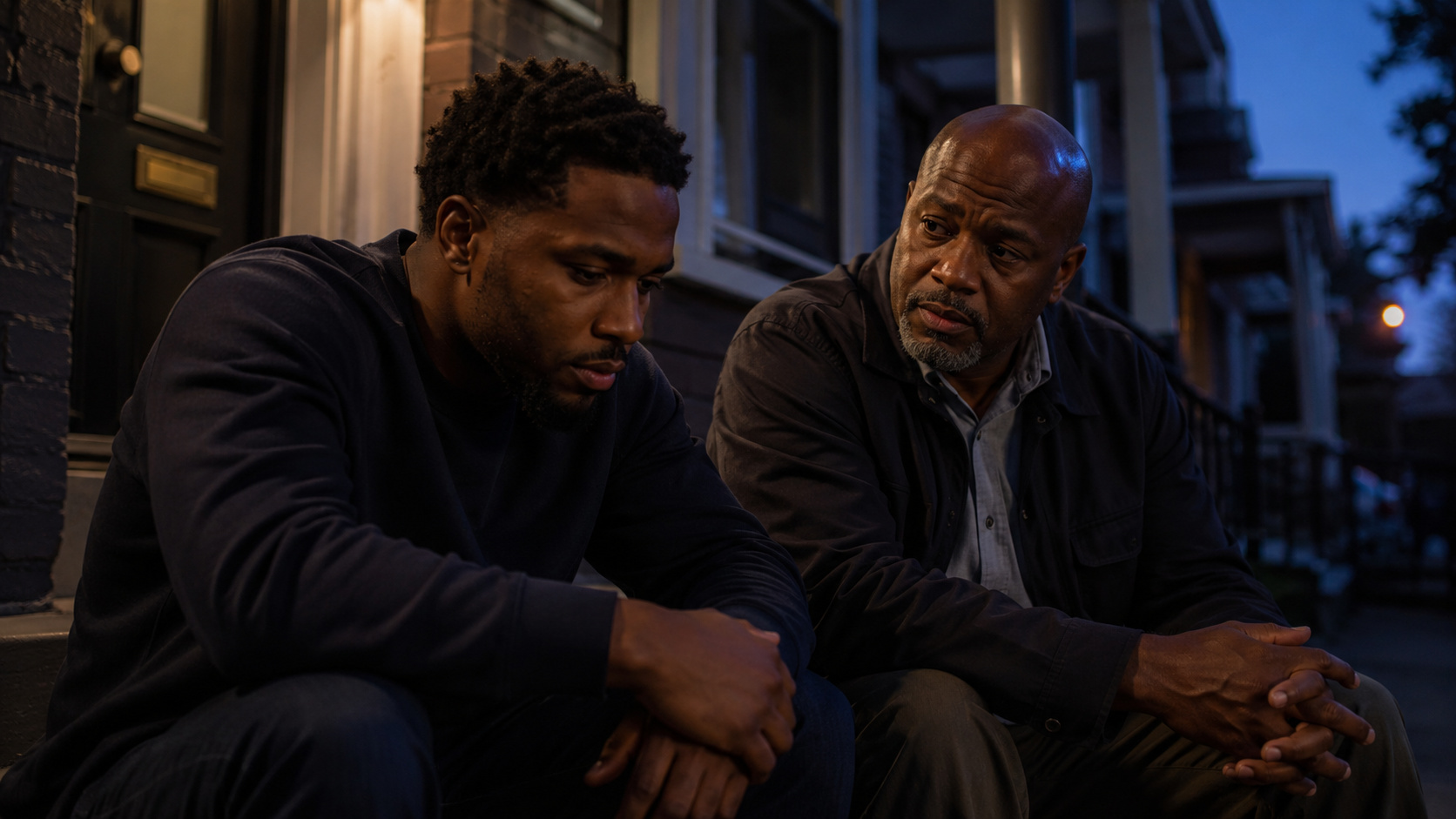
SEEN AS DANGEROUS,MISSED AS DEPRESSED
Black male pain is often recognized only after it becomes disruptive, dangerous, or fatal. This investigation examines rising suicide among Black men and boys, double consciousness, racialized misdiagnosis, firearm lethality, and why prevention must normalize both psychotherapy and psychiatry—not force people to choose between them.
KonCite · Black Mental Health Investigation
Seen as Dangerous, Missed as DepressedThe Rising Suicide Crisis Among Black Men and Boys—and the Care We Have Failed to Normalize
Black male distress is often recognized only after it frightens, disrupts, or inconveniences someone else. By then, the boy has become a discipline problem, the man has become a threat, and the illness has been allowed to deepen in plain sight.
Content note: This article discusses suicide and psychiatric crisis. In the United States, call or text 988 for immediate crisis support. If someone has an active plan or cannot remain safe, stay with them and seek emergency help.
THE PAIN WE KEEP MISNAMING
We have become very good at recognizing Black male pain when it becomes inconvenient to somebody else.
A boy stops turning in assignments, and the school records noncompliance. He becomes irritable, and adults call him disrespectful. He leaves the basketball team, stops answering friends, sleeps through the afternoon, gives away something he once treasured, or begins taking risks that do not resemble the child his family knows. The adults around him may see attitude, laziness, defiance, hormones, marijuana, bad friends, or a discipline problem.
What they may not see is depression.
A Black man arrives late, misses deadlines, drinks more, drives too fast, stops returning calls, becomes impossible to reach emotionally, or starts speaking about himself as though his existence has become a debt everyone else must pay. His family may call him distant. His supervisor may call him unreliable. The emergency department may call him agitated. Police may call him dangerous.
What they may not call him is ill.
That failure of recognition sits at the center of the rising suicide crisis among Black men and boys. The crisis is not simply that more Black males are experiencing despair. The crisis is that their despair is often forced to travel through institutions trained to interpret Black male behavior before they investigate Black male suffering.
We see the conduct. We miss the condition.
We document the disruption. We fail to diagnose the distress.
And then, after a death, we search backward through the silence and suddenly discover all the signs we had previously renamed.

KonCite Critical Finding
The rate is rising. Recognition and care have not kept pace.
Black men die by suicide at roughly four times the rate of Black women.
Sex differences in method lethality, treatment contact, substance use, isolation and help-seeking all matter. The ratio describes mortality—not who suffers more.
Reported suicide attempts among Black high-school students rose from 1991 through 2017.
The nationally representative analysis found a significant upward trend among Black adolescents while trends were flat or declining in several other groups.
Black children ages 5–12 had a higher suicide death rate than White children in a major national study.
The finding overturned assumptions that very young Black children were relatively protected from suicide mortality.
Firearm-suicide rates among Black teenagers surpassed those among White teenagers.
Because firearms are highly lethal, safe storage and temporary separation during crisis are clinical prevention—not political decoration.
THE NUMBERS ARE NOT THE EXPLANATION
Numbers can identify a crisis without explaining it.
The 73 percent increase in self-reported attempts among Black high-school students from 1991 through 2017 is not a diagnosis of Black adolescence. The higher suicide rate found among Black children ages five through twelve is not evidence of some new defect in Black childhood. The fourfold mortality difference between Black men and Black women does not mean Black women experience less suffering. Each statistic describes a different population, measure, time period, and route to death.
Together, however, they destroy a dangerous myth: that suicide is principally a White problem and that Black families are protected by resilience, spirituality, toughness, or familiarity with adversity.
Resilience is not a psychiatric diagnosis. Faith is not immunity. Strength is not the absence of major depression, bipolar disorder, psychosis, traumatic stress, addiction, or suicidal thinking.
When we romanticize Black survival, we can become less curious about Black suffering. We praise endurance so enthusiastically that we forget endurance has a physiological and psychological cost. We repeat that Black people have survived slavery, segregation, racial terror, poverty, policing, and exclusion—as though historical exposure to suffering should produce permanent resistance to despair.
That is not admiration. It is abandonment dressed as praise.
Sean Joe’s scholarship has been essential because it insists that Black suicide be studied on its own terms rather than treated as a statistical afterthought. Michael Lindsey and colleagues showed that the trajectory among Black adolescents was changing. Arielle Sheftall and colleagues disrupted the belief that very young Black children were comparatively protected. Rheeda Walker’s work has examined how racial stress, psychological fortitude, and culture shape suicide risk and protection among Black Americans.
These scholars did more than add Black faces to an existing literature. They forced the field to ask whether its theories, measurements, screening practices, and clinical assumptions were capable of recognizing Black distress before death made the evidence impossible to ignore.
How suffering becomes a behavior problem
Pain accumulates
Loss, racism, humiliation, violence, family instability, illness, isolation or psychiatric symptoms.
Distress changes behavior
Withdrawal, irritability, substance use, declining performance, agitation or risk-taking.
Institutions rename it
Defiance, laziness, danger, disrespect, poor character or criminality.
Punishment replaces assessment
Suspension, exclusion, police contact, workplace discipline or family conflict.
The illness deepens unseen
Less trust, less disclosure, less treatment and greater risk during crisis.
DOUBLE CONSCIOUSNESS INSIDE THE CLINICAL ENCOUNTER
W. E. B. Du Bois gave us language for the psychic labor of seeing oneself through one’s own eyes and through the gaze of a society that has already decided what Blackness means. Double consciousness is often taught as an elegant theory of identity. It is also a practical problem inside mental healthcare.
Before some Black men describe their pain, they conduct an internal risk assessment.
Will honesty make me look weak?
Will anger make them afraid of me?
Will they call police?
Will this enter my employment record?
Will medication change who I am?
Will the clinician understand racism as an exposure without deciding that race explains everything?
Will I be heard as a person in pain—or processed as a Black man who might become dangerous?
Frantz Fanon, who was both a psychiatrist and an anticolonial theorist, understood that racial domination enters the psyche. He refused the convenient fiction that mental illness exists outside history. Ralph Ellison’s language of invisibility helps explain how a person can be observed constantly while remaining unseen. James Baldwin understood what it costs to live inside other people’s distortions. bell hooks wrote against the emotional mutilation required by narrow forms of masculinity and insisted that love, accountability and emotional truth belong in any serious discussion of Black male life.
These literary voices should not be used as decorative quotations around a clinical article. They identify the social conditions under which disclosure occurs.
A Black man does not enter the therapy room as a brain detached from history. A Black boy does not enter a psychiatric assessment without prior experiences of school discipline, adultification, surveillance, or having his emotions interpreted as threat.
Clinical competence therefore requires more than cultural warmth. It requires diagnostic precision, knowledge of racism-related stress, awareness of differential punishment, careful assessment of substance use and trauma, and enough humility to ask what the patient believes will happen if he tells the truth.

WHY BLACK BOYS ARE PUNISHED BEFORE THEY ARE ASSESSED
Black boys often encounter systems that are exceptionally prepared to manage their behavior and remarkably unprepared to investigate its meaning.
A child who becomes withdrawn may disappear academically without creating enough disruption to trigger concern. A child whose depression appears through anger or impulsivity may receive immediate attention—but the attention may arrive through discipline rather than care. The same distress that might invite evaluation in another child can invite exclusion, suspension, security, or police contact in a Black boy.
This does not mean every episode of misconduct is psychiatric illness. It means that behavior should not be treated as proof that no illness exists.
Depression in boys and men may include sadness, but it can also involve irritability, emotional numbness, reckless behavior, substance use, sleep changes, social withdrawal, declining performance, hopelessness, shame, physical complaints, and a growing belief that one’s family would be better off without them. Bipolar disorder may involve periods of depression alongside decreased need for sleep, unusual energy, impulsivity, grandiosity or agitation. Psychosis may involve hallucinations, paranoia, disorganization or severe changes in functioning. Trauma may appear as vigilance, anger, dissociation, nightmares or avoidance.
The correct response is not to diagnose every difficult Black boy from a distance. It is to build pathways that allow concerning change to produce assessment rather than automatic punishment.
A school should know who performs suicide screening. A pediatric practice should know how to ask directly. A family should know that sudden improvement after severe distress can sometimes reflect a dangerous decision rather than recovery. Coaches, barbers, fraternity brothers, pastors and mentors can become bridges to care—but they should not be turned into unpaid substitutes for trained clinicians.
Community trust matters. Clinical skill matters. Both must be present.
THERAPY IS NOT PSYCHIATRY — AND WE NEED BOTH
For years, public conversation has used “therapy” as shorthand for all mental healthcare. That shorthand is no longer adequate.
Psychotherapy is treatment delivered through structured psychological and behavioral methods. Depending on licensure and training, it may be provided by psychologists, clinical social workers, professional counselors, marriage and family therapists, and psychiatrists. Therapy can help people process trauma, challenge hopeless beliefs, regulate emotion, repair relationships, reduce avoidance, build coping skills and develop a safety plan.
Psychiatry is a medical specialty. Psychiatrists are physicians. They assess psychiatric symptoms alongside medical illness, medications, sleep, substance use and neurological or endocrine contributors. They diagnose mental disorders, evaluate suicide risk, prescribe and monitor psychiatric medication, coordinate hospitalization when necessary, and may also provide psychotherapy.
Neither discipline should be presented as the morally superior form of care.
Some people need psychotherapy without medication. Some need medication and psychotherapy. Some need a psychiatric evaluation because the depression is severe, recurring or accompanied by psychosis, mania, catatonia, dangerous agitation, substance withdrawal, profound insomnia, or persistent suicidal intent. Some need medical testing because thyroid disease, medication effects, sleep disorders, neurological illness, chronic pain or substance use may be affecting mood and cognition.
Medication is not a spiritual failure. It is not proof that the family did not pray hard enough. It is not a surrender of Black strength.
Medication is also not magic. It cannot make an unsafe school safe. It cannot remove racism from a workplace. It cannot build a trustworthy relationship with a father. It cannot substitute for housing, food, sleep, belonging, grief support or protection from violence.
The point is not to choose between therapy and psychiatry.
The point is to stop offering partial care to people facing potentially fatal illness.
THERAPY IS NOT PSYCHIATRY — AND WE NEED BOTH
For years, public conversation has used “therapy” as shorthand for all mental healthcare. That shorthand is no longer adequate.
Psychotherapy is treatment delivered through structured psychological and behavioral methods. Depending on licensure and training, it may be provided by psychologists, clinical social workers, professional counselors, marriage and family therapists, and psychiatrists. Therapy can help people process trauma, challenge hopeless beliefs, regulate emotion, repair relationships, reduce avoidance, build coping skills and develop a safety plan.
Psychiatry is a medical specialty. Psychiatrists are physicians. They assess psychiatric symptoms alongside medical illness, medications, sleep, substance use and neurological or endocrine contributors. They diagnose mental disorders, evaluate suicide risk, prescribe and monitor psychiatric medication, coordinate hospitalization when necessary, and may also provide psychotherapy.
Neither discipline should be presented as the morally superior form of care.
Some people need psychotherapy without medication. Some need medication and psychotherapy. Some need a psychiatric evaluation because the depression is severe, recurring or accompanied by psychosis, mania, catatonia, dangerous agitation, substance withdrawal, profound insomnia, or persistent suicidal intent. Some need medical testing because thyroid disease, medication effects, sleep disorders, neurological illness, chronic pain or substance use may be affecting mood and cognition.
Medication is not a spiritual failure. It is not proof that the family did not pray hard enough. It is not a surrender of Black strength.
Medication is also not magic. It cannot make an unsafe school safe. It cannot remove racism from a workplace. It cannot build a trustworthy relationship with a father. It cannot substitute for housing, food, sleep, belonging, grief support or protection from violence.
The point is not to choose between therapy and psychiatry.
The point is to stop offering partial care to people facing potentially fatal illness.
Mental healthcare is an ecosystem
| Professional or service | Primary role | What they may provide | When especially important |
|---|---|---|---|
| Psychiatrist | Medical diagnosis and treatment | Psychiatric assessment, medication, medical differential diagnosis, hospitalization decisions, psychotherapy in some practices | Severe depression, bipolar disorder, psychosis, complex medication needs, persistent or acute suicide risk |
| Psychologist | Psychological assessment and psychotherapy | Evidence-based therapy, testing, diagnostic assessment, suicide-focused treatment | Trauma, depression, anxiety, behavioral concerns, cognitive or personality assessment |
| Clinical social worker or counselor | Psychotherapy and care navigation | Therapy, family work, crisis support, resource coordination | Ongoing treatment, relational stress, grief, trauma and system navigation |
| Primary-care or pediatric clinician | Front-door screening and medical assessment | Depression and suicide screening, initial medication in some cases, labs, referrals and follow-up | New symptoms, physical complaints, sleep change, medication or medical contributors |
| Emergency or crisis service | Immediate safety assessment | Acute evaluation, stabilization, safety planning, hospitalization or urgent referral | Active plan, intent, recent attempt, psychosis, inability to remain safe |
| Family, peers, faith and community | Connection and practical support | Presence, transportation, monitoring, encouragement, help following the safety plan | Every stage—but never as a substitute for clinical care during psychiatric crisis |
MEDICATION WITHOUT SHAME — AND WITHOUT MYTH
Black communities have good historical reasons to be cautious about medicine. Distrust did not fall from the sky. It was produced by unequal treatment, coercion, experimentation, dismissal, misdiagnosis and systems that have often been more willing to control Black behavior than relieve Black suffering.
That history must be acknowledged. It must not become a reason to abandon people who may benefit from psychiatric treatment.
Antidepressants, mood stabilizers, antipsychotic medications, medications for anxiety, and treatments for substance-use disorders are different classes with different indications, benefits, side effects and monitoring requirements. The correct question is not “Do you believe in medication?” as though pharmacology were a denomination.
The questions are clinical:
What symptoms are present?
How severe are they?
What diagnosis or diagnoses best explain them?
What medical conditions or substances could be contributing?
What treatment has been tried?
What are the benefits, risks, alternatives and monitoring plan?
For young people, treatment requires particular care. Medication decisions should involve development, family history, symptom course, safety monitoring and clear follow-up. Families should understand what changes require urgent contact. Medication should not be prescribed casually, and fear of medication should not block indicated care.
We should normalize psychiatric consultation without normalizing careless prescribing.
We should normalize medication without promising that medication alone can repair social injury.
We should normalize second opinions, questions, monitoring and patient autonomy.
Complete care is neither anti-medication nor medication-only. It is precise enough to use every appropriate tool and humble enough to recognize the limits of each one.
THE FIREARM QUESTION
Any honest investigation of Black male suicide must address firearms.
This is not because every suicidal person uses a firearm. It is because firearms are highly lethal, suicide crises can escalate rapidly, and the difference between immediate access and temporary distance can determine whether a person survives long enough for the crisis to change.
Among Black males, firearms are a leading method of suicide death. Recent youth trends make the issue more urgent. When firearm-suicide rates among Black teenagers surpassed those among White teenagers, the finding should have changed how families, clinicians, schools and community organizations discussed safe storage.
Safe storage means more than hiding a weapon. It may involve locked storage, unloaded storage, ammunition stored separately, and preventing access to keys or combinations. During a period of elevated risk, the safest arrangement may be temporary lawful storage away from the person in crisis, consistent with local law and professional guidance.
The purpose is not punishment. The purpose is time.
Suicidal intensity can change. A person may feel unable to survive an hour and feel differently after sleep, connection, treatment, medication, removal from conflict, sobriety, or simply the passage of time. A highly lethal method collapses the distance between impulse and death.
Lethal-means counseling is therefore not ideological theater. It is survival architecture.
Suicide prevention must be a pathway, not a referral
Withdrawal, agitation, hopelessness, sleep change, substance use, giving possessions away or speaking as a burden.
Ask about suicidal thoughts, plan, intent, timing and access to lethal means.
Stay present, remove lethal access, involve trusted people and use crisis services.
Psychiatric, psychological, medical, substance-use and family assessment as indicated.
Therapy, medication, hospitalization, safety planning, sleep and substance treatment according to need.
Rapid appointments, caring contacts, family support and repeated reassessment.
WHAT ACTUALLY PREVENTS SUICIDE
Suicide prevention is often reduced to awareness. Awareness matters, but awareness without an operating system leaves families informed and alone.
Evidence supports several concrete practices.
Direct questioning matters. Asking whether someone is thinking about suicide does not create suicidal thinking. It can reduce ambiguity and permit a more accurate assessment of risk.
Safety planning matters. The Stanley-Brown Safety Planning Intervention helps a person identify warning signs, internal coping strategies, people and places that provide distraction, individuals who can help, professional resources, and steps to make the environment safer. In a large emergency-department study among veterans, safety planning combined with structured follow-up was associated with fewer suicidal behaviors and greater treatment engagement than usual care.
Follow-up matters. Risk does not end when the emergency department discharges someone or the inpatient unit closes the chart. The days and weeks after a crisis require rapid appointments, caring contacts, medication follow-up where relevant, family education and clear instructions for what to do if risk returns.
Suicide-focused psychotherapy matters. Cognitive therapy and cognitive-behavioral approaches can directly address suicidal beliefs, hopelessness, problem solving and relapse prevention. Dialectical Behavior Therapy has strong evidence for reducing suicidal and self-harming behavior in appropriate populations. Treatment should not assume that improving a general diagnosis automatically resolves suicide risk.
Psychiatric treatment matters. Severe mood disorders, psychosis, substance-use disorders and other psychiatric conditions require diagnosis and treatment proportionate to their seriousness. Medication may be part of that treatment. Hospitalization may sometimes be necessary. The goal should be the least restrictive care that can reliably maintain safety—not avoidance of psychiatry until the crisis becomes unmanageable.
Connection matters, but connection must be operational. “Call me anytime” is less useful than agreeing who will stay tonight, who will hold the car keys, who will store the firearm, who will attend the appointment, who will manage medications, and who will call tomorrow morning.
Cultural responsiveness matters. A clinician does not become culturally competent by displaying a Black poster or saying the word trauma. The patient should not have to teach the provider why racism, adultification, religious language, masculinity, police exposure, financial responsibility or family reputation shapes the way distress is expressed and help is sought.
The strongest prevention plan is not one heroic conversation. It is a coordinated system that remains present after the immediate emotion has passed.
What complete suicide prevention can include
| Intervention | Primary purpose | Evidence-informed benefit | Important boundary |
|---|---|---|---|
| Direct suicide inquiry | Identify ideation, plan, intent and access | Improves disclosure and risk assessment; asking does not create suicidal ideation | Questions must lead to action when risk is present |
| Stanley-Brown safety planning | Create a practical crisis sequence | Associated with reduced suicidal behavior and improved follow-up engagement | Not a “no-suicide contract” and not a substitute for emergency care |
| Lethal-means counseling | Create time and distance from highly lethal methods | Reduces access during periods of acute risk | Must be specific, collaborative and legally appropriate |
| Suicide-focused CBT or cognitive therapy | Address hopelessness, beliefs, problem solving and recurrence | Can reduce repeat attempts in selected patients | Requires trained clinicians and ongoing safety assessment |
| Dialectical Behavior Therapy | Reduce suicidal and self-harming behavior while building regulation skills | Strong evidence in appropriate high-risk populations | Intensive model; availability and fit vary |
| Psychiatric assessment and medication | Treat underlying psychiatric illness and severe symptoms | May reduce depression, mania, psychosis, anxiety or substance-related risk | Requires diagnosis, monitoring, follow-up and informed consent |
| Rapid follow-up and caring contacts | Maintain connection after discharge or crisis | Supports engagement during a high-risk transition period | Must connect to accessible ongoing care |
| Family and school intervention | Reduce conflict, improve monitoring and create support | Can strengthen protective relationships and early recognition | Should protect confidentiality and avoid turning families into clinicians |
WHY “GO TO THERAPY” IS NOT A SYSTEM
“Black men need therapy” has become a culturally acceptable sentence. It is often offered as though it completes the analysis.
Therapy may be exactly what a person needs. It may also be unavailable, unaffordable, poorly matched, insufficiently frequent, culturally unsafe, or clinically incomplete. A weekly appointment cannot compensate for an active plan, a loaded firearm, untreated mania, severe alcohol withdrawal, command hallucinations, or the period immediately after a suicide attempt.
The phrase can also relocate responsibility onto the person in pain. He is told to find a provider, verify insurance, assess cultural fit, take time from work, arrange transportation, explain himself to a stranger, and remain hopeful through waiting lists—all while experiencing the illness that makes executive functioning, trust and hope more difficult.
Normalization must therefore extend beyond encouraging disclosure.
We need to normalize psychiatric evaluation.
We need to normalize medication when clinically indicated.
We need to normalize changing clinicians when care is dismissive or unsafe.
We need to normalize family participation without stripping the patient of dignity.
We need to normalize same-day crisis access, follow-up after discharge, substance-use treatment, sleep evaluation and the removal of lethal means.
We need to normalize asking a successful Black man whether he wants to live—not because he appears unstable, but because achievement has never been proof against despair.
The problem is not that Black men and boys refuse all help.
The problem is that the help presented to them is too often fragmented, culturally thin, administratively exhausting, or activated only after danger becomes visible to everyone else.

HOW TO ASK WITHOUT MAKING HIM PERFORM
The worst questions contain the answer we want.
“You are not thinking about doing something crazy, are you?”
“You would never do that to your mother.”
“You know you have too much to live for.”
Those sentences communicate fear, judgment and obligation. They tell the person that honesty will create a problem for the listener.
Use direct, calm language.
“I have noticed that you have stopped doing things you usually care about, and you sound exhausted. Sometimes when people feel trapped, they think about dying. Has that been happening to you?”
“Are you thinking about suicide?”
“Have you thought about how you would do it?”
“Do you have access to what you would use?”
“Have you decided when?”
“Can you stay with me while we get help?”
Do not debate whether the person has a good life. Do not demand gratitude. Do not ask him to prove love for the family by surviving the moment alone.
If there is an active plan, intent, recent attempt, severe intoxication, psychosis, or access to a lethal method, treat the situation as urgent. Stay present. Engage emergency or crisis services. Reduce access to lethal means. Do not promise secrecy.
The goal is not to deliver a perfect speech.
The goal is to help the person survive long enough for treatment, connection and time to alter what currently feels permanent.
BEYOND SURVIVAL
We have spent too long praising Black men for surviving systems that remain unwilling to care for them.
Survival is not treatment.
Endurance is not wellness.
Silence is not stability.
And a man’s usefulness to his job, family, church, fraternity, team or community is not evidence that he feels attached to his own life.
The intervention cannot begin at the funeral, when everyone suddenly becomes fluent in the language of warning signs. It must begin in pediatric visits, school hallways, locker rooms, barbershops, primary-care offices, emergency departments, psychiatric clinics, workplaces, churches, group chats and family kitchens.
But community presence must connect to clinical capacity.
The barber can notice.
The coach can ask.
The father can stay.
The pastor can accompany.
The friend can hold the keys.
The psychiatrist can assess.
The therapist can treat.
The health system can follow up.
The family can help make the environment safer.
No one person has to become the entire system. Everyone has to know their part.
We should not ask Black boys to become less emotional. We should stop punishing the forms their emotion is allowed to take.
We should not ask Black men to become less strong. We should build a definition of strength large enough to include medication, hospitalization, tears, boundaries, disclosure, rest and the decision to stay alive.
The goal is not to teach Black men and boys how to suffer more quietly.
The goal is to make sure they do not have to suffer alone—and that when they reach for care, the care is complete enough to meet them.
Stay. Ask. Protect. Connect.
If someone tells you he is thinking about suicide, believe the seriousness of the disclosure. Ask about plan, intent and access. Stay with him when danger is immediate. Create distance from firearms and other lethal methods. Connect him to crisis and clinical care—and remain involved after the first appointment.
United States: Call or text 988 for the Suicide & Crisis Lifeline. If there is an active plan, an attempt in progress, severe medical danger or an inability to remain safe, seek emergency assistance immediately.
CALL OR TEXT 988Sources and Notes
Peer-reviewed research, surveillance resources and Black intellectual traditions supporting the article’s analysis of suicide, diagnosis, treatment, double consciousness and culturally responsive care.
01Lindsey MA, Sheftall AH, Xiao Y, Joe S
Lindsey MA, Sheftall AH, Xiao Y, Joe S. Trends of suicidal behaviors among high school students in the United States: 1991–2017. Pediatrics. 2019;144(5):e20191187.
View source ↗02Bridge JA, Horowitz LM, Fontanella CA, et al
Bridge JA, Horowitz LM, Fontanella CA, et al. Age-related racial disparity in suicide rates among US youths from 2001 through 2015. JAMA Pediatrics. 2018;172(7):697-699.
View source ↗03Joe S
Joe S. Explaining changes in the patterns of Black suicide in the United States from 1981 to 2002: an age, cohort, and period analysis. Journal of Black Psychology. 2006;32(3):262-284.
View source ↗04Walker RL, Salami TK, Carter SE, Flowers K
Walker RL, Salami TK, Carter SE, Flowers K. Perceived racism and suicide ideation: mediating role of depression but moderating role of religiosity among African American adults. Suicide and Life-Threatening Behavior. 2014;44(5):548-559.
View source ↗05Lindsey MA, Joe S, Nebbitt V
Lindsey MA, Joe S, Nebbitt V. Family matters: the role of mental health stigma and social support on depressive symptoms and subsequent help seeking among African American boys. Journal of Black Psychology. 2010;36(4):458-482.
View source ↗06Stanley B, Brown GK, Brenner LA, et al
Stanley B, Brown GK, Brenner LA, et al. Comparison of the Safety Planning Intervention with follow-up vs usual care of suicidal patients treated in the emergency department. JAMA Psychiatry. 2018;75(9):894-900.
View source ↗07Brown GK, Ten Have T, Henriques GR, Xie SX, Hollander JE, Beck AT
Brown GK, Ten Have T, Henriques GR, Xie SX, Hollander JE, Beck AT. Cognitive therapy for the prevention of suicide attempts: a randomized controlled trial. JAMA. 2005;294(5):563-570.
View source ↗08Dazzi T, Gribble R, Wessely S, Fear NT
Dazzi T, Gribble R, Wessely S, Fear NT. Does asking about suicide and related behaviours induce suicidal ideation? What is the evidence? Psychological Medicine. 2014;44(16):3361-3363.
View source ↗09Du Bois WEB
Du Bois WEB. The Souls of Black Folk. 1903.
View source ↗10Fanon F
Fanon F. Black Skin, White Masks. 1952.
View source ↗11Ellison R
Ellison R. Invisible Man. 1952.
View source ↗12hooks b
hooks b. The Will to Change: Men, Masculinity, and Love. 2004.
View source ↗13Centers for Disease Control and Prevention
Centers for Disease Control and Prevention. Suicide Data and Statistics. Current surveillance resource.
View source ↗14988 Suicide & Crisis Lifeline
988 Suicide & Crisis Lifeline. Current crisis resource.
View source ↗